Azure West US Outage: When a Maintenance Change Breaks a Region
Why this matters right now
On July 23, 2026, a piece of routine maintenance took Microsoft’s Azure West US region off the map for roughly five hours. According to Microsoft’s own preliminary post-incident review, connectivity failed between 14:44 and 19:41 UTC, and around 27 services were degraded for any traffic entering or leaving the region (Network World). Services running entirely inside the region kept working; anything that had to cross the regional boundary did not.
The reason this belongs on a change manager’s desk, not just a network engineer’s, is the trigger. This was not a fiber cut, a power failure, or an attack. It was a change — a scheduled maintenance action — that went wrong because the automation meant to make it safe removed more than it should have. Reliability data says this is the common case, not the exception: 45% of major cloud incidents trace to configuration or change error, more than software defects and hardware failures combined (see the chart below). The Azure incident is a clean, well-documented example of that pattern, and it sits squarely in the cloud & SaaS reliability beat.
What actually happened in Azure West US
The mechanics are worth walking through slowly, because every step maps to a control a change advisory board already claims to run. Microsoft describes the work as “routine device maintenance” that required isolating specific network paths. To do that safely, the company says it “converts these requests into system-readable requests and verifies that at least one of the two redundant paths remains healthy,” and performs “safety checks to confirm the work will be impact-less” (The Register, quoting Microsoft’s PIR).
That verification step is exactly what a CAB would insist on: prove a redundant path survives before you touch anything. On paper, the change was safe. The failure lived one layer down, in the tool that translated the human request into machine actions. In Microsoft’s words, “a bug in the request conversion system incorrectly marked additional devices as a part of the maintenance event and caused a set of IP routes to be removed from more devices than intended,” and “the routes were removed between our datacenter and wide-area network, impacting traffic entering or exiting the region” (Network World).
Detection was fast. Microsoft says “multiple Azure services began to detect and correlate service degradation” almost immediately, and within a minute networking and service teams plus incident responders were “reviewing traffic anomalies, routing behavior, packet loss signals, and recent changes” (The Register). The incident “initially presented as large-scale route churn” in the wide-area network before responders traced it to the erroneous route removal. Recovery came through rollback — putting the incorrectly removed routes back — with full recovery at 19:41 UTC.
The safety check was the single point of failure
Here is the uncomfortable part for anyone who runs a change process. The control that was supposed to prevent impact — verify at least one redundant path stays healthy — did not fail loudly. It was bypassed silently, because the bug lived in the conversion layer that decided which devices the check applied to. If the tool feeds the safety check the wrong set of devices, the check happily passes on a scope that no longer matches reality.
One independent write-up put the takeaway bluntly: for teams on Azure West US, “your safety isn’t a second network path — it’s the automation that’s supposed to verify it before touching either one,” and that conversion layer “is a single point of failure” (Fusion42 analysis). That framing is the whole lesson. Redundancy did not save the region because the change tooling operated above the redundancy — it defined the blast radius before the redundant-path logic ever ran.
Change managers have a name-shaped blind spot here. We review the change (isolate device X for maintenance) and we review the rollback plan. We rarely review the tool that executes the change as itself a system that can fail. When a CAB approves “run the standard maintenance automation,” it is implicitly trusting that the automation’s request-conversion logic is bug-free. That trust is the risk. The same reflex should apply to your own deployment pipelines, feature-flag services, and infrastructure-as-code runners: they are change agents, and a defect in them has the blast radius of every change they touch.
How the numbers frame the risk
If this felt like a freak event, the aggregate data argues otherwise. The State of Cloud Reliability 2026 report attributes 45% of major cloud incidents to configuration or change error — described as “humans and automation, not hardware” — versus 21% for software defects and 11% for network or hardware failure (State of Cloud Reliability 2026, CloudDowntime). The same report puts the median major-incident duration at 204 minutes (about 3.4 hours), with the 90th percentile at 11 hours; Azure’s five-hour event sits above the median but well inside the normal range.
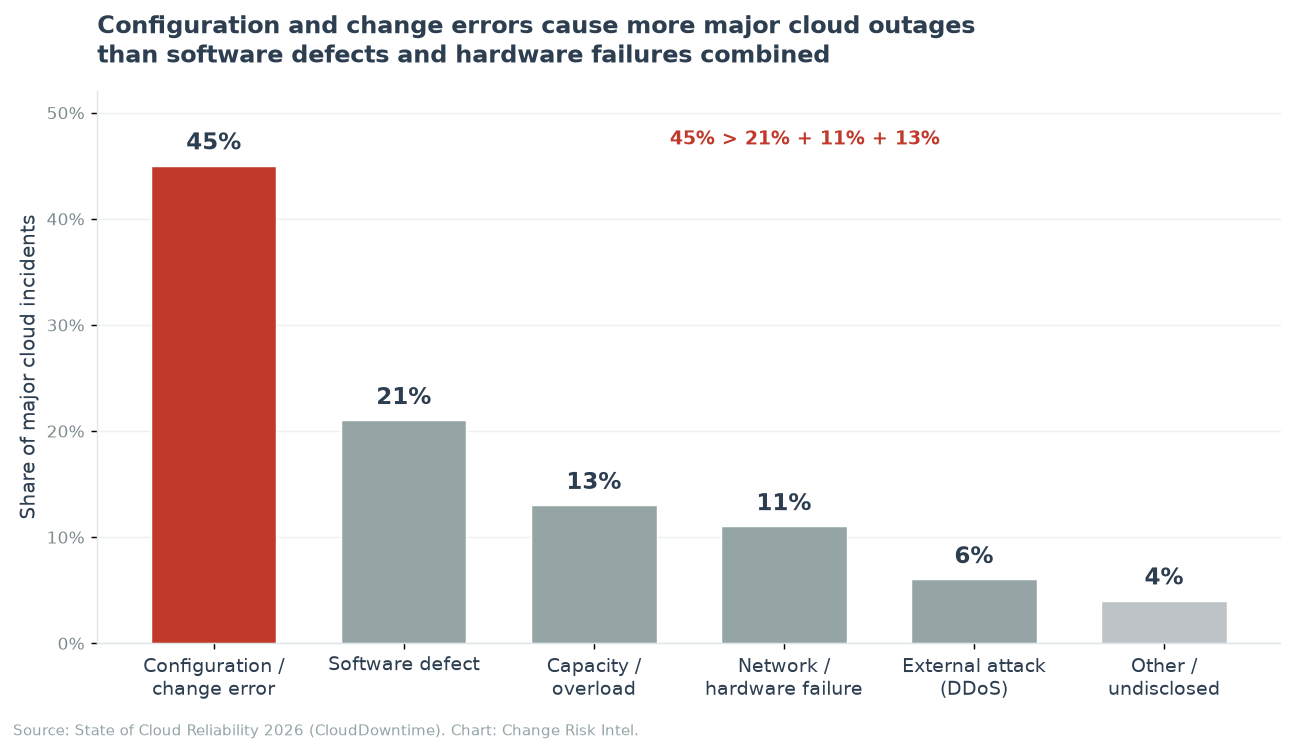
The report’s own conclusion is the sentence to tape to a CAB wall: “the industry’s biggest reliability lever is change safety, not redundancy” (State of Cloud Reliability 2026). Microsoft’s own engineering guidance agrees on where the leverage lives: its Well-Architected documentation states plainly that “all changes to the production workload are inherently risky” and that any code, IaC, feature-flag, or configuration update “you’re introducing risk to the workload” (Microsoft Learn: safe deployment practices). More cloud dependence plus change-driven failure as the leading cause is a combination that lands directly on change and risk teams.
It is also not Microsoft’s first change-driven outage of the year. Network World notes this was “the second significant” Azure disruption of 2026, following a roughly 10-hour event affecting US West and US East regions in February (Network World). Recurrence at the same provider is itself a signal for your vendor-risk register.
What good change safety looks like — from the vendor’s own playbook
The fix is not “trust the cloud less” in the abstract; it is to apply the discipline Microsoft itself publishes. Azure’s Well-Architected guidance on Safe Deployment Practices (SDP) rests on four ideas: safety and consistency for every production change, progressive exposure to limit blast radius, health models that must pass before each phase, and issue detection that “immediately” halts and initiates recovery (Microsoft Learn: Safe deployment practices). A maintenance action that can pull routes from an entire region in one shot is, by definition, not progressive exposure.
The honest weakness in the SDP model — and worth naming, because we do not run vendor puff pieces — is that progressive exposure is straightforward for application deployments and genuinely hard for shared network fabric. You cannot canary a route withdrawal to 1% of a region the way you canary a web release; the routing change is closer to all-or-nothing. That is precisely why the request-conversion layer needed stricter scope validation: when progressive exposure is not available, the compensating control has to be tighter blast-radius definition and a pre-flight diff of “devices this action will actually touch” against “devices approved.” The lesson generalizes to your own estate: for changes that resist canarying — DNS, routing, IAM, database schema — the safety budget has to shift from gradual rollout to scope verification and instant rollback.
What to do about it
Turn the Azure incident into a tabletop and a checklist. Concrete steps for your next CAB cycle:
- Inventory your change agents. List the automation that executes changes on your behalf — CI/CD runners, IaC pipelines, feature-flag services, maintenance schedulers. Each is a system whose defect inherits the blast radius of every change it runs.
- Require a pre-flight scope diff for high-blast-radius changes. Before a routing, DNS, IAM, or network-isolation change executes, produce the concrete list of resources it will touch and compare it against what was approved. Azure’s incident was a mismatch between intended and actual scope.
- Score maintenance changes for blast radius, not just novelty. “Routine” is not the same as “low-impact.” Use a structured rubric — our free change risk score tool gives you a starting scale — so a region-wide route change never rides through as a standard change.
- Rehearse cross-boundary failure, not just node failure. The region stayed up internally; only traffic crossing the boundary broke. Test your own failover to a different region, because in-region redundancy would not have helped here (Network World).
- Wire provider status into your change calendar. Track upstream cloud incidents beside your own change windows; our cloud status heatmap and the external risk sources every CAB should monitor guide show how to build that early-warning feed.
- Log recurrence in the vendor register. Two significant Azure outages in one year is a pattern worth recording next to the provider-of-provider risk you already track.
Frequently asked questions
What caused the Azure West US outage on July 23, 2026? A bug in Microsoft’s maintenance-request conversion system marked extra network devices for isolation and removed more IP routes than intended between the datacenter and the wide-area network, cutting cross-region traffic for about five hours (Network World).
How long did the outage last? Roughly five hours — 14:44 to 19:41 UTC on July 23, 2026 — with recovery achieved by rolling back the removed routes (Network World).
Was it a cyberattack? No. Microsoft attributes it to a bug in its own maintenance automation. Change and configuration errors, not attacks, drive about 45% of major cloud incidents (State of Cloud Reliability 2026).
Why didn’t redundancy prevent it? The safety check was fed the wrong device scope by a buggy conversion layer, so it validated a redundant path that no longer matched what the change actually touched (The Register via Network World).
What should a CAB learn? Treat change automation as a failure domain: require pre-flight scope diffs, score maintenance for blast radius, and rehearse cross-region failover, in line with Microsoft’s own Safe Deployment Practices.
Is multi-region enough? Only if you test it. In-region redundancy did not help because the failure broke cross-boundary traffic; Microsoft advised mission-critical workloads to consider multi-region (Network World).
Sources
- Network World: Microsoft explains why its West US Azure and cloud services failed
- The Register: Microsoft fiber foul-up cut off Azure California for almost five hours
- Microsoft Learn: Recommendations for safe deployment practices (Azure Well-Architected)
- State of Cloud Reliability 2026 (CloudDowntime)
- Fusion42: analysis of the Azure West US maintenance incident
- AWS Well-Architected: OPS06-BP04 Automate testing and rollback (change safety guidance)
Published July 27, 2026.