BOD 26-04: Pre-Wire Your Emergency Change Before the Clock
This article is operational change-management guidance for CAB, ECAB, and infrastructure teams. It is not incident-response, legal, or compliance advice. Validate every remediation step against the vendor advisory for your own deployment. No affiliate links appear below.
Table of contents
- Why a three-day clock breaks a normal change process
- What BOD 26-04 actually changed
- The decision table, mapped to an ECAB response track
- A live worked example: the Oracle WebLogic flaw
- Pre-wiring the standing emergency change
- What to do about it
- Frequently asked questions
- Sources
Why a three-day clock breaks a normal change process
Most change advisory boards run on a rhythm measured in weeks. A change gets submitted, waits in a queue, collects sign-offs, and lands in a scheduled maintenance window. That cadence assumes the cost of waiting is lower than the cost of moving without review.
A federal remediation deadline inverts that assumption. Under CISA’s Binding Operational Directive 26-04, the highest-risk vulnerabilities carry a three-calendar-day clock, and the clock does not start when a patch ships. It starts when CISA adds the flaw to the Known Exploited Vulnerabilities catalog, or when an agency finds it on an asset, whichever comes first (CISA BOD 26-04). Patch availability is irrelevant to when your budget begins.
No normal CAB cadence survives contact with a 72-hour window, and the assets that trigger it are rarely back-office. They are the internet-facing middleware, load balancers, and management planes that front production traffic. If your team is still deciding who can approve an out-of-band patch on day two, you have already spent a third of the budget on a governance question that should have been answered months earlier. The fix is not to move faster during the incident. It is to decide, in advance, which specific risk profiles automatically qualify for the emergency-change path.
What BOD 26-04 actually changed
BOD 26-04, titled “Prioritizing Security Updates Based on Risk,” was issued on June 10, 2026, and it supersedes and revokes two long-standing directives: BOD 22-01, which created the KEV catalog in 2021 with a roughly two-week remediation clock, and BOD 19-02 from 2019 (CISA BOD 26-04). The old model gave nearly every newly cataloged KEV entry the same deadline. The new model does not.
Instead, BOD 26-04 scores each vulnerability against four binary variables drawn from CISA’s Stakeholder-Specific Vulnerability Categorization methodology:
- Publicly exposed — is the asset reachable from an untrusted network such as the internet?
- In the KEV — has CISA confirmed active exploitation in the wild?
- Automatable — can an adversary automate every step of the exploit?
- Technical impact — does exploitation grant partial or total control of the system?
CISA publishes its own answers for variables two, three, and four through the Vulnrichment program, so agencies only have to determine exposure themselves (Nucleus Security, navigating BOD 26-04). Four yes/no inputs produce sixteen combinations, and each combination maps to one of five outcomes in Table 1 of the directive: three days plus forensic triage, three days, fourteen days, sixty days, or “fix on system upgrade.” The effect on the catalog has been sharp. Of the 45 KEV entries added between June 10 and August 7, 2026, forty carried a three-day deadline and only five carried fourteen (Stingrai analysis of the KEV feed).
Two details matter for change planning. First, the three-day tier is not KEV-exclusive: an internet-facing asset with an automatable, total-control flaw gets 72 hours even if CISA has not yet cataloged it (Stingrai). Second, the directive treats its timelines as dynamic. Take a system off the internet and the exposure variable flips, relaxing the window; for the top tier, CISA also accepts a mitigation action, not only a completed patch, as meeting the deadline (Zafran). Both facts are levers a change team can pull on the clock.
The decision table, mapped to an ECAB response track
The directive tells you the deadline. It does not tell you who approves the change. That gap is where change management earns its keep. ITIL defines an emergency change as one that must be implemented immediately, assessed and authorized not by the full CAB but by the Emergency Change Advisory Board, a small standing subset of CAB members reachable on short notice (IT Process Wiki, Change Management). The ECAB exists precisely to cut through a queue when waiting would cause more damage than acting.
The practical move is to overlay the ECAB onto BOD 26-04’s own table, so the deadline tier decides the approval track before any specific CVE appears. The chart below maps all sixteen rows to a response track: the top-tier rows route straight to a pre-authorized emergency change, the 14-day rows to an expedited normal change, and the rest to the standard queue or backlog.
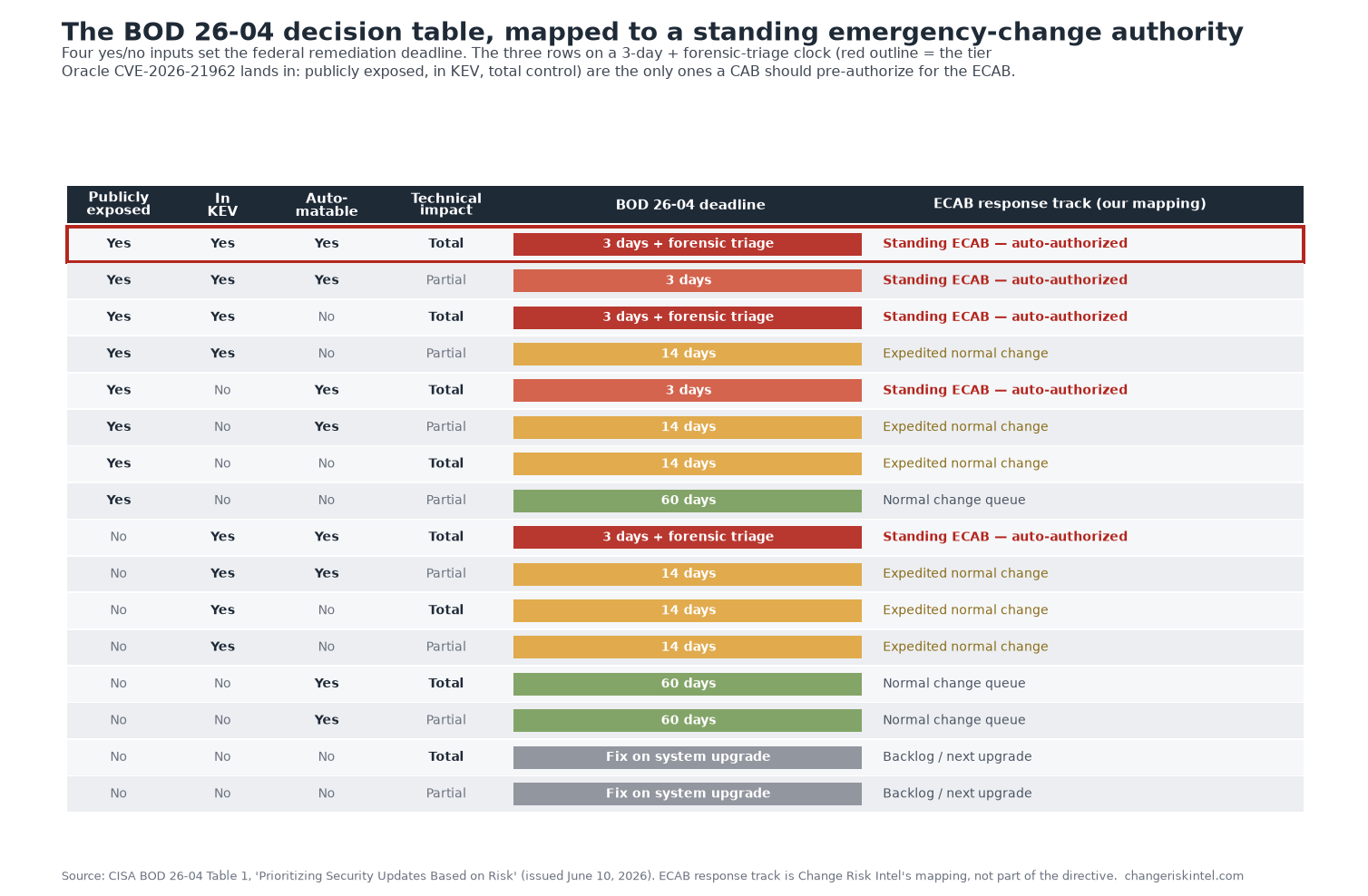
Read the table as a filter, not a to-do list. The three rows that land on “3 days + forensic triage” — and the two additional rows that land on a plain three-day clock — are the only ones that should ever hit the ECAB automatically. Everything on a 14-day or 60-day window has room for an expedited-but-normal review, which keeps your emergency path rare, legible, and defensible when an auditor asks why a given change skipped the full board. An emergency path that fires on every KEV entry is not an emergency path; it is a broken normal process wearing a costume.
One caution on the mapping: the ECAB response track is our operational overlay, not part of the directive. BOD 26-04 binds federal civilian agencies, and its forensic-triage requirement is a compliance obligation for them (CISA BOD 26-04). A private-sector CAB is free to adopt the same tiering voluntarily, and many do, because the four variables describe real-world risk regardless of who owns the asset.
A live worked example: the Oracle WebLogic flaw
Abstract tables persuade nobody at 9 a.m. on a Monday. So walk a current one through the model. On August 24, 2026, CISA added CVE-2026-21962 to the KEV catalog and set a remediation due date of August 27 — the three-day tier (NVD CVE-2026-21962 record). The flaw is an improper access control weakness in Oracle HTTP Server and the Oracle WebLogic Server Proxy Plug-in, and it carries a CVSS score of 10.0, the maximum (Oracle Critical Patch Update, January 2026).
Score it against the four variables. Oracle HTTP Server is proxy middleware that, by design, sits at the network edge in front of application servers — publicly exposed, yes. It is in the KEV as of August 24 — yes. The CVSS vector describes an unauthenticated attacker sending specially crafted HTTP requests, the kind of thing that scripts and scans well — automatable, yes. And successful exploitation grants unauthorized creation, deletion, and modification of data across the affected servers (California Cybersecurity Integration Center advisory). That is total control. Four yeses put it on the top row of the table: three days plus forensic triage, the red-outlined row in the chart.
That routing decision should be automatic. The moment a KEV entry scores four yeses, your ECAB is already authorized to act — no scheduled board, no waiting for the next window. What still requires human judgment is the technical response, and here the vendor and government advisories give a clean sequence. Confirm the affected version trains against the Oracle advisory rather than assuming a WebLogic server patch also covers the proxy plug-in, which is patched separately and frequently missed (Cal-CSIC advisory). If you cannot patch inside the window, the exposure lever applies: restricting external reach to the affected component is a recognized mitigation, and for the top tier BOD 26-04 accepts a mitigation as meeting the clock (Zafran). The forensic-triage half of the requirement is not optional theater. A total-control flaw exploited in the wild means the working assumption is that the door may already have been used, so the change record has to include evidence the asset was checked, not just patched.
Note the weakness on both sides of any tooling choice here. The Oracle advisory itself gates patch downloads behind a support login, which slows teams without an active contract; and network-layer mitigation via a WAF or load balancer buys time but does not remediate, so a team that stops at the mitigation and never patches will fail the next retest. Name both trade-offs in the change record so the decision is legible later.
Pre-wiring the standing emergency change
The entire point of the table overlay is that the hard decisions happen once, in a quiet CAB meeting, not sixteen times under a clock. A standing emergency-change authorization is a short, written pre-approval that says: when a vulnerability scores into the top tier of BOD 26-04, the ECAB is authorized to implement remediation without a scheduled board, subject to named guardrails. Build it before you need it.
The guardrails are what keep it from becoming a blank check. Define the exact trigger — top-tier score, confirmed against the CISA catalog entry, on an asset in a maintained inventory. Name the standing ECAB roster and a quorum that works at 2 a.m. Require a post-implementation review at the next full CAB so the shortcut is reviewed, not hidden. And require the change record to capture the four-variable score, the source advisory, the mitigation-versus-patch decision, and the forensic-triage result. That record is what turns a rushed patch into a defensible change, and it is the artifact an auditor or an ad-network compliance reviewer will actually read.
The reusable asset is the trigger logic, not the CVE. Every product-specific scramble — a load balancer one week, a mail server the next — is the same table applied to a new row. Wire the table once and the next flaw is a lookup, not a fire drill.
What to do about it
- Print the BOD 26-04 table and score your last five emergency patches against it. If any of them were not top-tier, your emergency path is firing too often; if any top-tier flaw went through the normal queue, it is firing too rarely.
- Write a one-page standing emergency-change authorization keyed to the top-tier rows, and get it approved at a full CAB while nothing is on fire.
- Name a standing ECAB roster with an after-hours quorum, and test that you can actually convene it in under an hour.
- Build the four-variable score into your change ticket template so every emergency change records exposure, KEV status, automatability, and technical impact.
- Add a mandatory forensic-triage field to any change that scores total control plus confirmed exploitation, and require evidence before the ticket closes.
- Confirm your asset inventory can answer the exposure question fast, because it is the one variable CISA does not score for you.
Score your own next candidate change with our free change risk score tool, and keep an eye on the live CISA KEV feed so a top-tier entry never surprises you. For the broader discipline behind this, see the change management pillar.
Frequently asked questions
What is CISA BOD 26-04? It is a binding operational directive CISA issued on June 10, 2026, that replaces flat KEV deadlines with a 16-row table setting a remediation window of 3 days, 14 days, 60 days, or next upgrade based on four yes/no variables. It supersedes BOD 22-01 and BOD 19-02.
When does the BOD 26-04 remediation clock start? When CISA adds the vulnerability to the KEV catalog, or when an agency identifies it on an asset, whichever comes first. Patch availability does not start it, and the days are calendar days.
Do all KEV entries now carry a three-day deadline? No. An entry can carry 3 or 14 days depending on exposure, automatability, and impact, though the catalog has shifted sharply toward three days. The correct answer for any specific CVE is the due date on its own KEV entry.
What is the difference between a CAB and an ECAB? The CAB reviews planned changes on a schedule; the ECAB is a small standing subset reachable on short notice that authorizes emergency changes when waiting would cause more damage than acting.
Does BOD 26-04 apply to private companies? It legally binds only federal civilian agencies and their FedRAMP cloud providers, but many private CABs voluntarily adopt the same tiering because it maps to real risk.
What does forensic triage mean under BOD 26-04? For the highest-risk rows, the agency must both remediate within three days and assess whether the asset was already compromised, on the assumption that an exploited, exposed, total-control flaw may already have been used.
Can a mitigation instead of a patch meet the three-day deadline? Yes, for the top tier a mitigation action can meet the clock, and removing public exposure can relax the timeline — but a mitigation is temporary and does not remove the obligation to patch.
This piece is part of the change management pillar at Change Risk Intel.
Sources
- CISA, Binding Operational Directive 26-04: Prioritizing Security Updates Based on Risk
- NVD, CVE-2026-21962 detail record
- Oracle Critical Patch Update Advisory, January 2026
- California Cybersecurity Integration Center, Oracle WebLogic Proxy Plug-in advisory
- Nucleus Security, navigating the requirements of CISA BOD 26-04 (full Table 1)
- Stingrai, BOD 26-04 and the 72-hour KEV clock (full Table 1 and feed analysis)
- Zafran, BOD 26-04 signals the end of patch-everything
- IT Process Wiki, Change Management and the Emergency Change Advisory Board
Published August 26, 2026.