Vanta vs Drata vs Secureframe: Evidence Collection Compared
This is a capability comparison for evaluation purposes, built from each vendor’s own public documentation, and it names at least one limitation of each platform. It is not compliance, legal, or audit advice, and it is not a substitute for a scoping conversation with your auditor. Some outbound links may be affiliate links. Where a vendor page did not state a verifiable figure, no count is asserted.
Why this matters
Compliance automation platforms all make the same promise: connect your stack, and they collect the evidence an auditor wants without the screenshot-and-spreadsheet grind. The promise is real, but the platforms are not interchangeable. The differences show up exactly where a maturing program feels the most pain — when you outgrow the out-of-the-box frameworks, need to prove a control that lives in an on-premises system, or have to hand an auditor clean, read-only access to your evidence.
This comparison looks at Vanta, Drata, and Secureframe through one lens that matters to change and risk teams: how each handles evidence collection, custom controls and frameworks, continuous monitoring, and auditor access. Every claim here comes from the vendor’s own documentation, and each platform gets at least one named limitation. If you are building a compensating-controls program, the platform is where that register lives day to day, which is why the compensating controls register work depends on picking a tool whose custom-control model fits.
The common ground: what all three do
Before the differences, the shared baseline. All three platforms map controls and automated tests to major frameworks such as SOC 2 and ISO 27001, run automated tests against connected systems, and surface evidence for an auditor rather than requiring manual screenshots for every control. Secureframe’s documentation describes pre-built automated tests plus the ability to create custom tests, collecting evidence through automated tests and operational checks (Secureframe automated evidence collection). Vanta’s evidence-collection documentation lists automated test evidence, automated test history, and screenshot evidence captured through its agent (Vanta evidence collection). Drata’s continuous-monitoring documentation describes monitoring across control categories with pre-mapped controls (Drata continuous monitoring).
The framing that unites them is continuous control monitoring rather than point-in-time evidence. That approach mirrors what NIST describes in its guidance on information security continuous monitoring — maintaining ongoing awareness of controls rather than assessing them once a year (NIST SP 800-137). For a SOC 2 Type II report, which the AICPA describes as covering the operating effectiveness of controls over a period (AICPA SOC 2), continuous collection is the point.
Custom controls and frameworks: where they split
This is the dimension that separates the three most clearly, and it is the one that bites when your program matures past the templates.
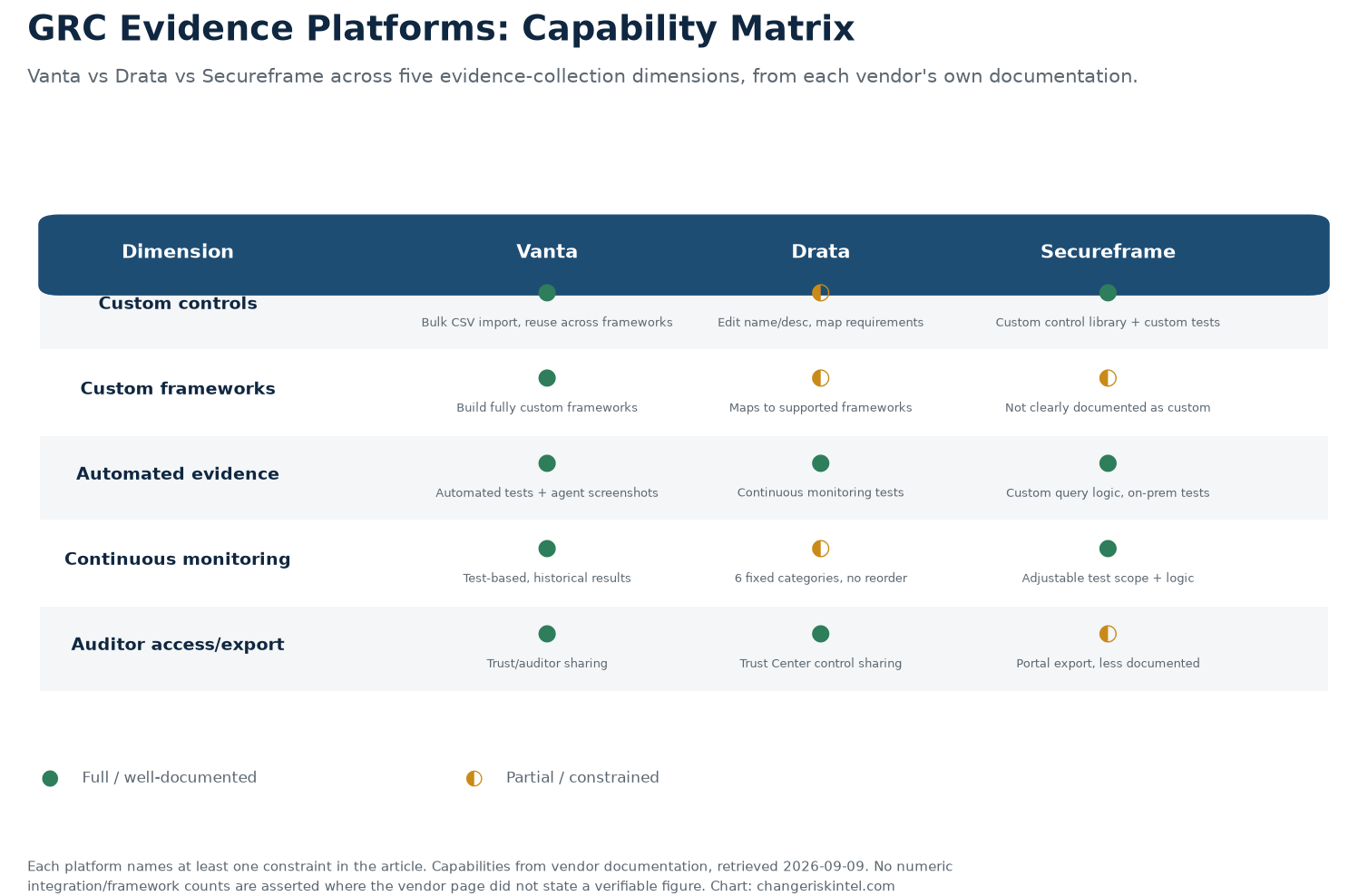
Vanta documents the most explicit custom-framework capability. Its custom-frameworks product page describes building fully custom frameworks and controls for requirements beyond its supported set, uploading or creating controls, importing custom controls in bulk via CSV, and mapping a single control to multiple frameworks to reduce duplicate work (Vanta custom frameworks). For a team facing a bespoke customer-security questionnaire or a niche regulation, that CSV bulk import and cross-framework mapping is the differentiator.
Secureframe sits in the middle. Its documentation describes a pre-built control library, the ability to create custom controls, and notably custom automated tests with custom query logic, adjustable test logic, adjustable test scope, and testing for on-premises systems (Secureframe automated evidence collection). The on-premises testing point is worth flagging: many automation platforms assume a fully cloud-native stack, so a documented on-prem testing path matters if your evidence lives partly in a data center. The limitation: Secureframe’s public documentation is clearer about custom controls and custom tests than about creating an entirely custom framework from scratch, so confirm that path directly if a fully bespoke framework is a hard requirement.
Drata is the most constrained on this axis in its public documentation. Its continuous-monitoring view organizes controls into six categories that, per the documentation, cannot be changed or reordered, and a control can appear in only one category at a time in the Trust Center (Drata continuous monitoring). At the individual-control level, Drata’s documentation describes editing a control’s name and description and mapping framework requirements to it, but is not explicit about creating fully custom controls or frameworks (Drata assess and manage controls). That fixed-category structure is tidy for a standard SOC 2 program but is a real constraint if you need to reshape how controls are grouped and presented.
Continuous monitoring and auditor access
On continuous monitoring, all three run automated tests on a recurring basis, but the presentation differs. Vanta’s model is test-centric with historical test results, Secureframe’s stands out for adjustable test scope and logic plus the on-prem path already noted, and Drata’s is category-based with the ordering constraints described above. The named weakness pattern holds: Vanta’s agent-based screenshot collection is powerful but means deploying and maintaining an agent; Secureframe’s flexibility comes with more test configuration to manage; Drata’s structure is the least flexible to reshape.
Auditor access is the last mile of any evidence platform, because a report only gets produced if the auditor can see the evidence cleanly. Drata’s documentation describes sharing controls through a Trust Center, and both Vanta and Secureframe provide auditor-facing sharing or export paths. Here the honest limitation is documentation depth rather than a capability gap: the exact read-only scoping and export formats are less fully specified in public docs than the collection features, so this is a dimension to test in a trial with your actual auditor rather than take on the marketing page. The capability matrix below summarizes the five dimensions.
The change-management angle
For a change and risk program, the platform choice is not just a compliance-team decision. The evidence platform becomes the system of record for whether your controls are operating, and that overlaps directly with change management: a change that alters a monitored control should show up as a failing or passing test, and the register of compensating controls you attach to risk deferrals has to live somewhere the auditor will accept.
There is a second overlap that teams miss. These platforms score and monitor controls, but they do not know which of your systems matter most unless you tell them. The asset criticality work that feeds your change process should also feed the platform’s scoping, so that a high-impact system is not monitored with the same weight as a low-impact one. If your criticality model is inconsistent between the two, you get either alert fatigue on trivial systems or blind spots on important ones, the same failure mode described in the asset criticality scoring work. Reconcile the two so the platform monitors what your change process already treats as critical.
Whichever platform you choose, treat the integration between your change process and the evidence platform as its own reviewed change, and confirm that a control-affecting change produces a visible signal. This is the same discipline covered in the broader tools comparisons pillar: match the tool to the workflow you already run, and pressure-test how a proposed rollout scores with the change risk score tool before you commit.
What to do about it
If you are choosing among the three, work the decision in this order:
- Write down your framework list first. If it includes anything beyond the common set (SOC 2, ISO 27001), check whether you need a fully custom framework. If yes, Vanta’s documented CSV bulk import and custom-framework support is the strongest fit on paper.
- Locate your evidence. If material evidence lives in on-premises systems, prioritize Secureframe’s documented on-prem test path, and confirm the specifics in a trial.
- Check how you group controls. If your program needs a standard, tidy SOC 2 structure, Drata’s fixed six-category model is fine; if you need to reshape control groupings, treat that fixed structure as a constraint.
- Test auditor access with your actual auditor. Do not rely on marketing pages for read-only scoping and export — run a trial and have your auditor confirm the workflow.
- Map the platform to your change process. Require that a control-affecting change produces a visible test signal, and decide where your compensating-controls register will live.
Frequently asked questions
Which platform is best for custom frameworks? Vanta documents the most explicit fully-custom-framework capability, including bulk control import via CSV and mapping one control to multiple frameworks, while Secureframe documents custom controls and tests but is less explicit about entirely custom frameworks, and Drata’s public documentation is not explicit about fully custom controls or frameworks.
Do any of these platforms support on-premises evidence? Secureframe’s documentation explicitly describes testing for on-premises systems as part of its custom automated tests, which matters because many platforms assume a cloud-native stack; confirm the specifics in a trial.
What is Drata’s main limitation for evidence collection? Its continuous-monitoring view uses six fixed control categories that cannot be reordered, and a control can appear in only one category at a time in the Trust Center, which constrains teams needing to reshape control groupings.
Is continuous control monitoring required for SOC 2? A SOC 2 Type II report covers operating effectiveness over a period per the AICPA, so continuous collection supports that model better than point-in-time checks, consistent with NIST’s continuous-monitoring guidance.
How should the platform connect to change management? Treat it as a system of record for control operation — a change that alters a monitored control should produce a visible test signal, and the change-to-platform integration should itself be a reviewed change.
Sources
- Vanta — Custom controls and frameworks
- Vanta — Evidence collection (Help Center)
- Drata — Continuous monitoring (Help Center)
- Drata — Assess and manage individual controls (Help Center)
- Secureframe — Automated evidence collection
- Secureframe — Custom controls and frameworks
- NIST — SP 800-137, Information Security Continuous Monitoring
- AICPA — SOC 2 examinations
Published September 9, 2026.