Asset Inventory Reconciliation: The Quarterly Change
This post is written for change and risk managers, not as legal or compliance advice. It names a limitation of every tool and framework it recommends. Some outbound links may be affiliate links; they never change what we cover or how we assess it.
Why this matters
Our asset exposure discovery comparison ended on a single instruction: run one external view against one internal view and reconcile the gap. That sentence hides a real workflow, and skipping it is why the exposure question keeps ambushing teams during incidents. This post ships the workflow as a repeatable quarterly change.
The gap is not hypothetical. One external-attack-surface study found that organizations running standard discovery programs are aware of roughly 62 percent of their actual external footprint, leaving about 38 percent unseen, and that more than 70 percent of 2025 incidents involving internet-facing systems started at an unknown or unmanaged asset (Brandefense external attack surface analysis). The cloud picture is worse: the same analysis reports enterprises typically believe they use around 91 cloud services when the real number averages more than 1,200. You cannot patch, monitor, or emergency-change an asset that never made it into the record, and the attacker reaches it first.
Frameworks already assume you close this gap. What they do not give you is the change-management scaffolding to make it happen on a schedule, with an owner, and with an auditable output. That scaffolding is the point of this post.
What do the frameworks actually require?
Three standards converge on the same idea from different angles. CIS Critical Security Control 1 tells you to “actively manage (inventory, track, and correct) all enterprise assets … connected to the infrastructure physically, virtually, remotely, and those within cloud environments … to accurately know the totality of assets,” explicitly so you can identify “unauthorized and unmanaged assets to remove or remediate” (CIS Control 1). The verb “correct” is the reconciliation mandate: an inventory you never check against reality is a document, not a control.
CIS puts a clock on it. Safeguard 1.1 requires an accurate, detailed inventory recording the network address, hardware address, machine name, owner, department, and “whether the asset has been approved to connect to the network” (CIS Safeguard 1.1). Safeguard 1.2 then requires a process to address unauthorized assets on a weekly basis, with the options to remove, deny remote connection to, or quarantine the asset. NIST SP 800-53 control CM-8 reinforces the automation: its enhancements call for maintaining inventory currency, completeness, and accuracy through automated mechanisms, and for detecting unauthorized hardware, software, and firmware components (NIST SP 800-53 CM-8). The federal cadence is the most concrete of all: CISA’s BOD 23-01 requires automated asset discovery every seven days across the entire IPv4 space an agency uses, and vulnerability enumeration across all discovered assets every fourteen days.
The weakness in all three is that they specify the outcome, not the operating rhythm. None tells you who runs the comparison, what a mismatch triggers, or how the result becomes a change record. That is the gap this quarterly change fills.
How does the reconciliation matrix work?
Reconciliation is a join between two lists: the external view (what Shodan or Censys can see from the internet) and the internal view (what runZero or your cloud-native inventory says you run). Every asset lands in one of four cells, and only the diagonal is safe.
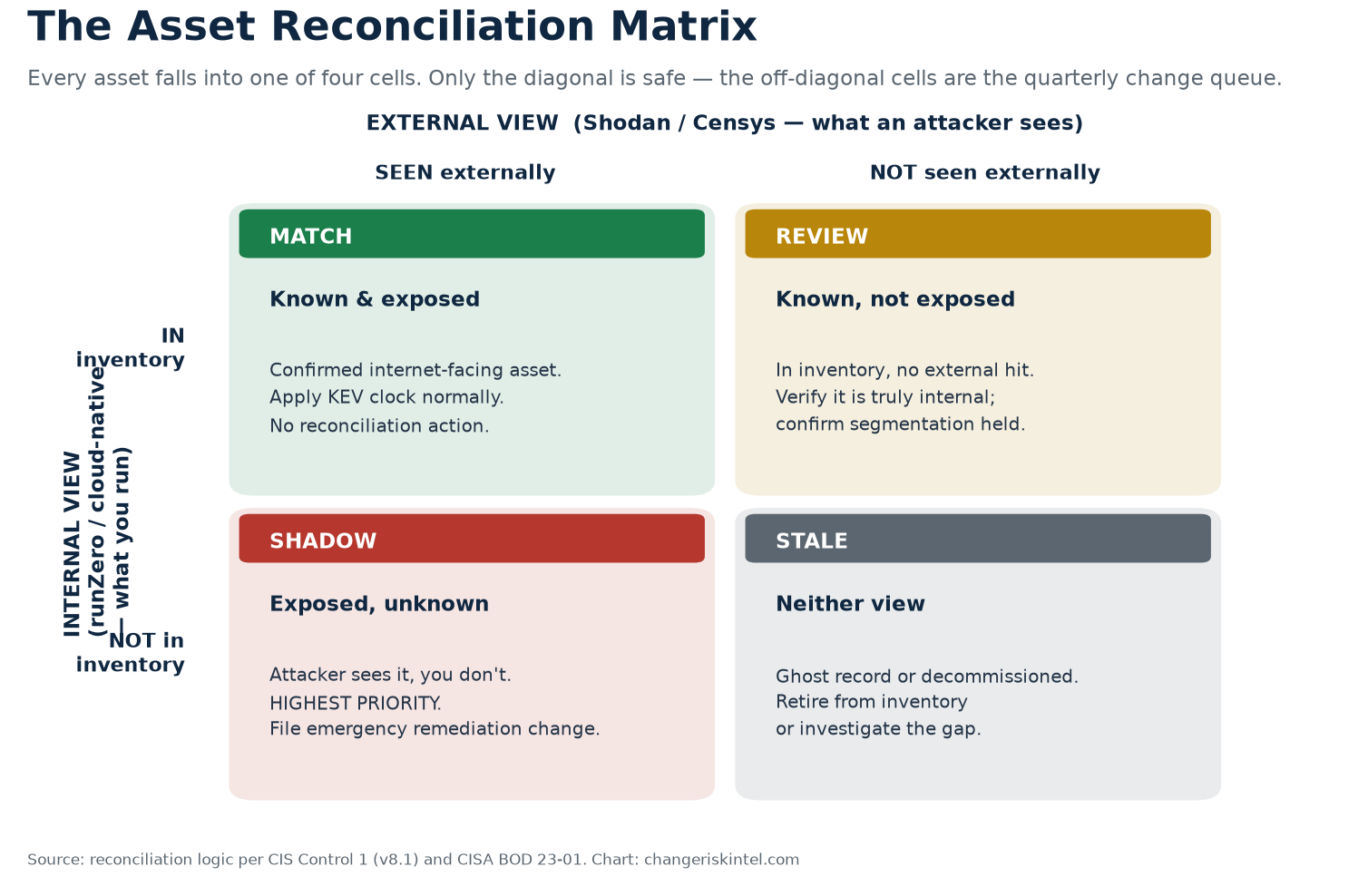
The two off-diagonal cells are the entire reason to run the change. The red cell (an asset the internet can see that your inventory does not list) is a shadow asset, and it is where the 38 percent lives. It gets the highest priority because an attacker has already found it and you have no owner, no patch cadence, and no monitoring on it. The grey cell, a record in your inventory that no scan can find inside or out, is usually a ghost: a decommissioned host still carrying a CMDB entry, or a mistyped range. It matters less for attack surface but it corrupts every downstream metric, because a KEV-affected “asset” that no longer exists still shows up as unremediated.
The amber cell deserves a second look rather than a shrug. An asset that is in your inventory but not visible externally is the expected state for internal systems, but it is also what a misconfigured segmentation rule looks like right up until someone exposes it. Verifying that the “not exposed” reading is intentional, not accidental, is cheap during a scheduled reconciliation and expensive during an incident.
What does the quarterly change look like end to end?
Treat the reconciliation as a standard change with a change record, not a background script nobody reads. The steps below are the change plan.
First, freeze the inputs. Pull the external view and the internal view within the same 24-hour window so you are comparing current state to current state, not last month’s scan to today’s inventory. Export both to a common key — IP address plus port is the most reliable join for internet-facing assets, with hostname as a secondary match.
Second, compute the four cells. A spreadsheet join or a short script is enough; the deliverable is four lists, not a dashboard. Count each cell and record the counts in the change record, because the quarter-over-quarter trend in the red cell is your single best attack-surface metric.
Third, triage the red cell immediately. Each exposed-but-unknown asset gets an owner assigned and a remediation change filed the same day. If the asset also carries a live CISA KEV entry, it inherits that deadline, which can turn a routine reconciliation into an emergency change. That is not a reason to defer the reconciliation; it is the reconciliation doing its job.
Fourth, work the amber and grey cells on a normal change cadence. Amber assets get a segmentation verification task. Grey assets get either a retirement change (if truly decommissioned) or an investigation (if the gap is unexplained). None of these should block the change from closing, but all of them should be tracked to completion before the next quarter.
Where does the KEV clock intersect this?
The link between a slow inventory and a fast deadline is the whole risk. When PaperCut disclosed two actively exploited NG/MF flaws — CVE-2026-82078 (CVSS 9.4) and CVE-2026-81578 (CVSS 8.8), added to the CISA KEV catalog on September 1, 2026 with a September 14 remediation deadline — its own emergency bulletin told customers to first restrict any internet-facing Application Server to trusted IP addresses “even if no suspicious activity has been observed,” then patch (PaperCut security bulletin; Cybersecurity Dive).
Read that instruction as a reconciliation in miniature. “Find every internet-facing PaperCut server” is exactly the red-cell question, and a team that already knows which print servers are exposed answers it in minutes. A team that does not spends the first day of a compressed KEV clock discovering its own footprint, which is the worst possible time to learn you own an asset. The quarterly reconciliation front-loads that discovery so the emergency change starts from a known list instead of a scramble. Feed the reconciled exposure list into your change risk score and the emergency-change decision is driven by confirmed exposure rather than a guess.
What to do about it
- Schedule the reconciliation as a recurring quarterly change with a named owner, not a cron job nobody reviews. Put the four cell counts in the change record every time.
- Standardize the join key before the first run: IP plus port as primary, hostname as secondary, so external and internal exports line up automatically.
- Pull both views inside the same 24-hour window so you compare current state to current state.
- Triage the red cell (exposed and unknown) the same day: assign an owner and file a remediation change; inherit any live KEV deadline.
- Verify the amber cell (known, not exposed) is intentional segmentation, and retire or investigate the grey cell (ghost records) so they stop polluting your remediation metrics.
- Between quarters, keep CIS Control 1.2’s weekly unauthorized-asset process running so the reconciliation confirms a trend rather than discovering a backlog.
Frequently asked questions
What is asset inventory reconciliation? It is the scheduled comparison of an external asset view against your internal inventory, where every mismatch becomes work — shadow assets to remediate, ghost records to retire.
How often should you reconcile asset inventory? Run a full reconciliation at least quarterly as a formal change, and address newly found unauthorized assets weekly per CIS Control 1.2. BOD 23-01’s seven-day discovery cadence is a useful private-sector benchmark.
What frameworks require asset inventory reconciliation? CIS Control 1 (correct the inventory across physical, virtual, remote, and cloud), NIST SP 800-53 CM-8 (automated accuracy and unauthorized-component detection), and CISA BOD 23-01 (federal cadence).
What is a shadow asset and why does it matter for change management? An internet-reachable system your inventory does not list, so it has no owner, patch cadence, or monitoring — and an attacker finds it first, which is why it is the highest-priority reconciliation outcome.
How does reconciliation connect to the CISA KEV clock? A recently reconciled team already knows which affected instances are exposed and starts remediation immediately; an un-reconciled team burns the first day of the clock discovering its own footprint.
What join key should you use to reconcile external and internal asset views? IP plus port as primary, hostname as secondary, with both views pulled inside the same 24-hour window.
What do you do with the four reconciliation outcomes? KEV clock for known-and-exposed, segmentation check for known-not-exposed, same-day remediation change for exposed-but-unknown, and retire or investigate records neither view can find.
For more cloud and SaaS reliability playbooks, see our cloud & SaaS beat.
Sources
- CIS — Control 1: Inventory and Control of Enterprise Assets
- CIS — Safeguard 1.1 (detailed enterprise asset inventory)
- NIST SP 800-53 — CM-8 System Component Inventory
- CISA — BOD 23-01: Improving Asset Visibility and Vulnerability Detection
- PaperCut — Urgent security bulletin (27 Aug 2026)
- Cybersecurity Dive — PaperCut emergency patches as threat actors chain vulnerabilities
- Brandefense — The 62% problem: external attack surface
Published September 2, 2026.