Retry Storms as a CAB Check: GitHub's RCA and AWS's New Defaults
No affiliate links appear in this article. Incident facts come from GitHub’s own status-page root cause analyses, and retry defaults come from vendor and project documentation, all linked inline and in Sources. The amplification figures are arithmetic from those documented defaults, not load testing.
Table of contents
- Why this matters
- What happened at GitHub on October 30?
- Why do retries turn small faults into outages?
- What changed in the AWS SDK retry defaults on November 10?
- How do common clients cap retries by default?
- What should a CAB ask about client retry behavior?
- What to do about it
- FAQ
- Sources
Why this matters
Most change reviews ask what the change does to the system being changed. Far fewer ask what the clients of that system will do when it hiccups. GitHub’s October 30 root cause analysis is a clean example of why that second question matters: the maintenance itself was routine, and the outage came from how a client library reacted to it.
The same week the question got a second angle. AWS made its updated SDK retry behavior the default on November 10, 2026, which means a routine dependency bump can now change how your services back off, how quickly they give up, and how many attempts they make. That is a change with blast radius, even if the pull request only touches a lockfile.
Retry behavior sits in an awkward spot for change control. It lives in client code and library defaults, it rarely shows up in a change record, and it only matters when something else is already failing. This piece walks through the GitHub case, the arithmetic behind retry amplification, the AWS default change, and a short set of questions a change advisory board can add to its review.
What happened at GitHub on October 30?
GitHub’s status page gives this account of the incident, which ran from 17:50 to 18:32 UTC with full resolution posted at 19:23 UTC:
- Actions, Pages and Webhooks were delayed, and code search and live updates returned errors.
- The trigger was “maintenance on a cloud network gateway connecting an Actions service in the GitHub data center to Redis clusters in the Central US Azure region.”
- “The service’s Redis client retried aggressively and redialed those connections.” That produced a connection storm that saturated the gateway, with about 90% of connection attempts failing.
- Other services sharing the same network path were degraded too.
- Responders mitigated by removing the affected resources from rotation.
The follow-up items are the useful part for a CAB. GitHub says it reduced retries and is working on “jittered backoff, shorter connect timeouts, and retry budgets,” along with work with its infrastructure team to make GitHub more resilient to gateway maintenance. Those four items map almost one to one onto the review questions later in this article.
Two things stand out. First, the change that triggered the incident was on a shared network path, not on the Actions service, so a review scoped to “what does this gateway maintenance touch” would have listed the gateway, not the Redis client behind it. Second, the damage spread sideways: services that shared the path but had nothing to do with Actions were hurt by the storm. GitHub’s report does not name the Redis client library, and we won’t guess at it.
A second GitHub incident ten days later shows the capacity side of the same problem. On November 9, a planned Actions database migration to a new cloud region sent traffic that “exceeded the capacity and rate limits configured there,” affecting an average of 28% of workflow runs and peaking at 65% between 18:07 and 18:59 UTC. GitHub shifted part of the traffic back, raised limits, then moved traffic gradually, and now validates capacity and limits before shifting, in smaller steps. A destination’s rate limits are only half the picture; the other half is how hard callers push when they start getting rejected.
We covered the October 30 RCA briefly in our week of November 2 recap. This is the longer treatment.
Why do retries turn small faults into outages?
The AWS Builders’ Library article on timeouts and retries puts it plainly: “Retries are ‘selfish.’” A retry spends more of the server’s time to raise one caller’s chance of success. When failures are rare, that trade is fine. When failures come from overload, the same article says, retries “can even delay recovery by keeping the load high long after the original issue is resolved.”
Google’s SRE book chapter on addressing cascading failures gives the mechanics. Its worked example has a backend that tops out at 10,000 QPS, receives 10,100 QPS, and then sees retry traffic grow from 100 to 200 to 300 QPS as rejected requests come back. The excess never drains because the retries themselves are the excess.
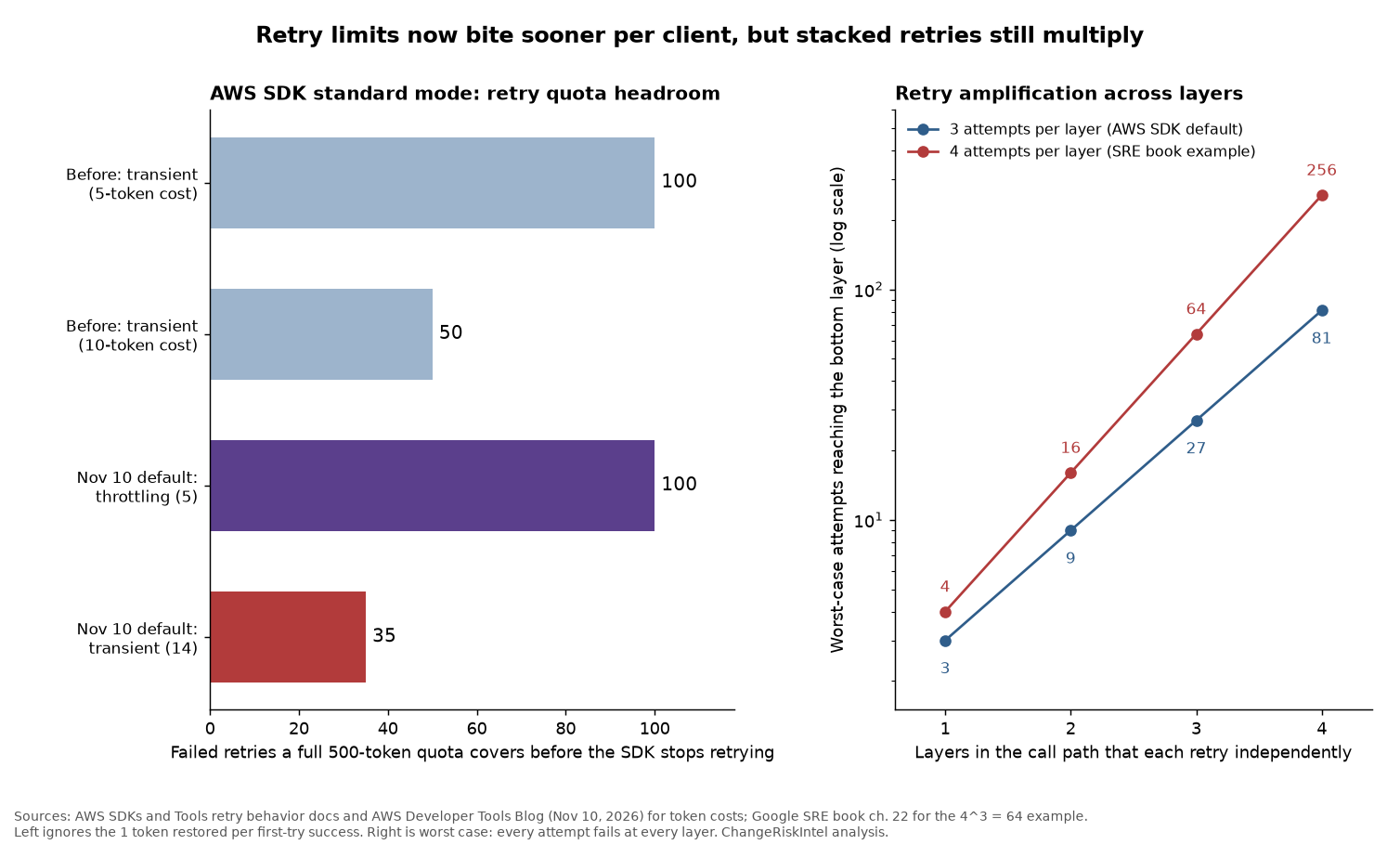
The second mechanic is stacking. The SRE book’s example has three layers (a JavaScript client, a frontend and a backend), each making up to four attempts. One user action can then produce 4³ = 64 attempts at the database. Its advice is to retry at only one layer of the stack, which matches the Builders’ Library guidance to “retry at a single point in the stack.”
The right panel of our chart extends that arithmetic. With the AWS SDK’s default of 3 attempts at each layer, worst-case attempts at the bottom layer go 3, 9, 27, 81 as you add layers that each retry independently. With 4 attempts per layer it is 4, 16, 64, 256. This is a ceiling, not a forecast: it assumes every attempt fails at every layer. But a dependency outage is exactly the condition where that assumption gets close to true.
The SRE book also names the change-management link directly. It lists planned changes, drains and turndowns among the triggers of cascading failure, advises responders to “check for recent changes and consider reverting them,” and warns that changes meant to reduce background errors, such as adding retries on failure, “can increase the risk of a full outage.” It also notes that a retry-rate graph can be misread as a symptom when it is part of the cause.
What changed in the AWS SDK retry defaults on November 10?
AWS first announced the updated behavior in May as an opt-in using the AWS_NEW_RETRIES_2026 environment variable. Its November 10 post says that starting November 10, 2026, the updated behavior is the default, the opt-in flag is removed, and availability varies by SDK. The post lists the first version carrying the new default for each SDK, for example botocore 1.44.0, Java 2.x 2.58.0, JavaScript 3.1166.0, Go 2.x v1.48.0 and AWS CLI 2.40.0. Kotlin is listed as “to be announced.”
The changes, per AWS:
- Faster first retries. Transient errors such as connection resets and HTTP 500/502/503/504 use a 50 ms base delay; throttling errors use 1,000 ms. AWS’s May announcement says the first retry after a brief 503 now averages about 25 ms, “down from hundreds of milliseconds or more.”
- A stricter retry quota. Each transient-error retry now costs 14 tokens from a 500-token bucket (previously 5 or 10 depending on SDK and error), and each throttling retry costs 5. AWS says this means “the quota engages sooner during sustained outages.”
- Standard mode becomes the default where legacy was. The November post names the SDKs for Python, Java, Ruby, PHP and Swift as previous
legacydefaults; the May post lists Java, Python, Ruby, PHP, C++ and the AWS CLI. Check your SDK’s tracking issue rather than either list. For these SDKs, the change adds a standardized retry quota where there may not have been one. - DynamoDB tuning. DynamoDB and DynamoDB Streams clients use a 25 ms base delay and 4 max attempts. AWS notes that previous defaults went as high as 12 max attempts in some SDKs.
The retry behavior reference documents the backoff formula as a random fraction of the smaller of 20 seconds and the base delay times 2 to the power of the retry number, a default of 3 max attempts (one request plus two retries), and a quota rule: when the budget reaches zero, “the SDK stops retrying and returns errors directly to your code.”
On balance this is a change toward the behavior GitHub says it is building: jittered backoff plus a retry budget that cuts off retries during sustained failure. The left panel of our chart shows the effect: a full bucket now covers about 35 failed transient retries before the client stops retrying, against 50 to 100 under the old costs (ignoring the 1 token restored per first-try success). That is good for the dependency. It still changes what your application sees, and AWS lists the risks itself:
- Max attempts may have gone down, so “if your workload relied on a high retry count, you may see more errors.”
- SDKs gaining a retry quota for the first time will surface errors sooner during prolonged outages.
- The quota “activates sooner for transient errors, such as a wave of 500 responses.”
The rollback path has its own trap. AWS says a complete revert is not available in every SDK, and that setting AWS_RETRY_MODE=legacy in a shared environment can backfire: some SDKs and tools reject legacy, which “causes an error when the configuration loads, or causes the entire config profile to be ignored, including credentials and Region.” A rollback plan that sets one environment variable on a shared host can break a different tool on the same host.
How do common clients cap retries by default?
The table below collects documented defaults for clients and proxies that commonly sit between a service and its dependencies. It shows where a budget exists out of the box and where one has to be configured. Weaknesses are noted for each.
| Client or layer | Documented default attempts | Backoff | Budget or circuit breaker | Watch-out |
|---|---|---|---|---|
| AWS SDK standard mode (AWS) | 3 attempts | Exponential with full jitter; 50 ms transient, 1,000 ms throttling base, 20 s cap | 500-token quota; 14 per transient retry, 5 per throttling retry | Defaults shifted Nov 10; legacy rollback not accepted by every SDK |
| AWS SDK, DynamoDB clients (AWS) | 4 attempts | 25 ms base | Same quota | Some SDKs previously allowed as many as 12 attempts |
| AWS SDK adaptive mode (AWS) | As standard | As standard | Adds a client-side rate limiter | Limiter is per client instance, so many instances still add up |
| gRPC (gRPC docs) | No default policy; transparent retries only | Configured per service, e.g. 0.1 s initial, 1 s max, multiplier 2 | Optional retryThrottling token bucket | Nothing caps configured retries unless throttling is set |
| Envoy cluster circuit breaker (Envoy docs) | max_retries 3 concurrent retries when unset | Set in route retry policy | Optional retry_budget: 20% of active requests, minimum concurrency 3 | Budget is opt-in; proxies add another retrying layer |
| Azure Retry pattern guidance (Microsoft) | Guidance, not a single default | Recommends increasing delays | Recommends pairing with Circuit Breaker | Guidance only; each SDK and app sets its own values |
Two patterns stand out. A per-client budget, like the AWS quota or gRPC throttling, limits how hard one client pushes, but a fleet of a few hundred instances behind the same gateway still multiplies the total. And a service mesh or proxy that retries in front of an SDK that also retries is the two-layer case from the chart, unless someone has deliberately turned one of them off.
What should a CAB ask about client retry behavior?
These questions fit any change that can briefly drop or slow connections on a shared path: gateway, load balancer, firewall, DNS, proxy or service mesh maintenance, database failovers and migrations, cache or Redis cluster changes, and certificate rotations on shared endpoints. They also apply to SDK and HTTP client upgrades that change retry defaults.
- Who is behind this path? List the client services, not just the component being changed. GitHub’s maintenance was on a gateway; the storm came from a client behind it, and the damage hit neighbors sharing the path.
- How many attempts, at how many layers? Record max attempts for the SDK, the HTTP or Redis client, the proxy or mesh, and any application-level retry loop. If more than one layer retries, say which one should, per the “retry at one layer” guidance from Google and AWS.
- Is there backoff with jitter, and a connect timeout? Reconnect loops with no jitter synchronize. Long connect timeouts hold threads and connections open while the path is saturated. Both were on GitHub’s fix list.
- What caps retries across the fleet? Name the budget, quota or circuit breaker, and whether it is per instance or global. “The SDK handles it” is an answer only if someone has checked the SDK version and mode.
- Can we drain instead of cut? Shift traffic off the path gradually before maintenance, the way GitHub now moves Actions traffic in smaller steps after validating limits.
- What do we watch, and what triggers rollback? Add retry rate and connection-attempt rate to the change’s monitoring, next to error rate. Agree in advance that a rising retry rate during the window is a rollback trigger, not noise. Microsoft’s Retry pattern guidance suggests logging early failures as informational and only the final failed attempt as an error, which keeps the error signal readable.
- Is the operation safe to retry? The Builders’ Library is direct that “APIs with side effects aren’t safe to retry unless they provide idempotency.” Changes that will trigger client retries against write paths need an idempotency answer.
Our change risk score tool can carry the outcome of these questions: a shared-path change with multi-layer retries and no fleet-wide budget should score higher on dependency blast radius than the component alone suggests. For provider-side maintenance and incidents, the cloud provider standing agenda is the place to log what happened and which of your clients reacted.
What to do about it
- Add a “client reaction” line to shared-path change templates. For gateway, proxy, DNS, database and cache changes, require the list of client services and their retry settings. If nobody can fill it in, that is a finding.
- Treat SDK upgrades that change retry defaults as normal changes, not standard ones. AWS’s November 10 update changes max attempts, quota costs and backoff at once. Test on non-production first, as AWS recommends, and write down any previous value you are restoring and why.
- Plan rollback per application, not per host. Because
legacycan break config loading in some AWS SDKs and tools, set retry mode in code or in an application-specific profile rather than in a shared environment variable. - Pick one retrying layer per call path. Where a mesh or proxy retries and the SDK also retries, turn one of them down deliberately and record which.
- Put retry rate on the change dashboard. Count retries and reconnect attempts alongside errors during maintenance windows, and make a rising retry rate an explicit rollback trigger.
- Revisit past incidents through this lens. Our AWS us-east-1 outage history shows how far downstream retries reach in a large region. Ask, for each recent incident, whether retries extended the recovery tail.
FAQ
What is a retry storm?
A retry storm is when many clients retry failed requests at about the same time, so retry traffic keeps a struggling dependency overloaded and can spread the failure to other services sharing the same path. Google’s SRE book describes this as one route to cascading failure.
What caused GitHub’s October 30, 2026 outage?
GitHub says maintenance on a cloud network gateway between an Actions service and Redis clusters in Azure Central US caused the service’s Redis client to retry aggressively and redial. The resulting connection storm saturated the gateway, about 90% of connection attempts failed, and other services on the same network path degraded.
What changed in the AWS SDK retry defaults?
As of November 10, 2026, AWS made its updated retry behavior the default in listed SDK versions. Transient errors use a 50 ms base delay, throttling uses 1,000 ms, transient retries cost 14 tokens from a 500-token quota, DynamoDB clients default to 4 attempts, and SDKs that defaulted to legacy mode move to standard.
Should a CAB review SDK upgrades?
When an upgrade changes retry defaults, yes. AWS itself notes that some workloads may see more errors because max attempts dropped or a retry quota now applies. That is a behavior change with production impact, so it deserves a test plan and a rollback plan.
How do you prevent retry storms?
Use exponential backoff with jitter, retry at only one layer of the stack, set short connect timeouts, and cap retries with a budget or circuit breaker. Drain traffic gradually before maintenance on shared paths, and watch retry rates during the change window.
Sources
- GitHub Status: Incident with Actions, Pages, and Webhooks, October 30, 2026 (RCA)
- GitHub Status: Incident with Actions and Checks API, November 9, 2026 (RCA)
- AWS Developer Tools Blog: Updated default retry behavior for AWS SDKs and tools (November 10, 2026)
- AWS Developer Tools Blog: Announcing updated retry behavior for AWS SDKs and Tools (May 2026)
- AWS SDKs and Tools Reference Guide: Retry behavior
- Amazon Builders’ Library: Timeouts, retries, and backoff with jitter
- Google SRE book: Addressing Cascading Failures
- gRPC: Retry guide
- Envoy: Circuit breakers (proto) reference
- Microsoft Azure Architecture Center: Retry pattern
Published November 16, 2026.