Status Page Aggregators Compared: StatusGator vs IsDown
Disclosure: this article contains no affiliate links. Pricing and features were taken from each vendor’s own site in July 2026 and may change. Verify current terms before purchasing.
Why this matters
Your change advisory board spends its meetings arguing about the risk of changes you control. The changes that actually take you down are increasingly the ones you do not: a Stripe degradation, a GitHub Actions stall, an Okta blip, an AWS regional event. When a vendor you depend on has an incident, your team needs to know before your customers tell you, because the cost of finding out late is brutal. Roughly 90% of mid-sized and large enterprises now lose more than $300,000 for every hour of downtime, and the Splunk and Cisco “Hidden Costs of Downtime 2026” figure lands near $15,000 a minute, per Gatling’s downtime-cost analysis.
Status page aggregators solve the detection half of this problem. Instead of a human tab-checking a dozen vendor status pages, an aggregator watches thousands of them and pings your team the moment one goes red. That turns a vendor outage from a surprise into a tracked event your CAB can fold into its incident and change process, the same way we argued third-party dependencies belong on the board’s radar in our guide to the external risk sources every CAB should monitor. This piece compares the three tools operators ask about most: StatusGator, IsDown, and IncidentHub. Every one of them has a real weakness, and we name it.
How the three compare on catalog and price
The single most important number for an aggregator is how many of your vendors it already tracks. A cheap tool that does not cover your payment processor is worthless. Here is the July 2026 picture, pulled from each vendor’s own site.
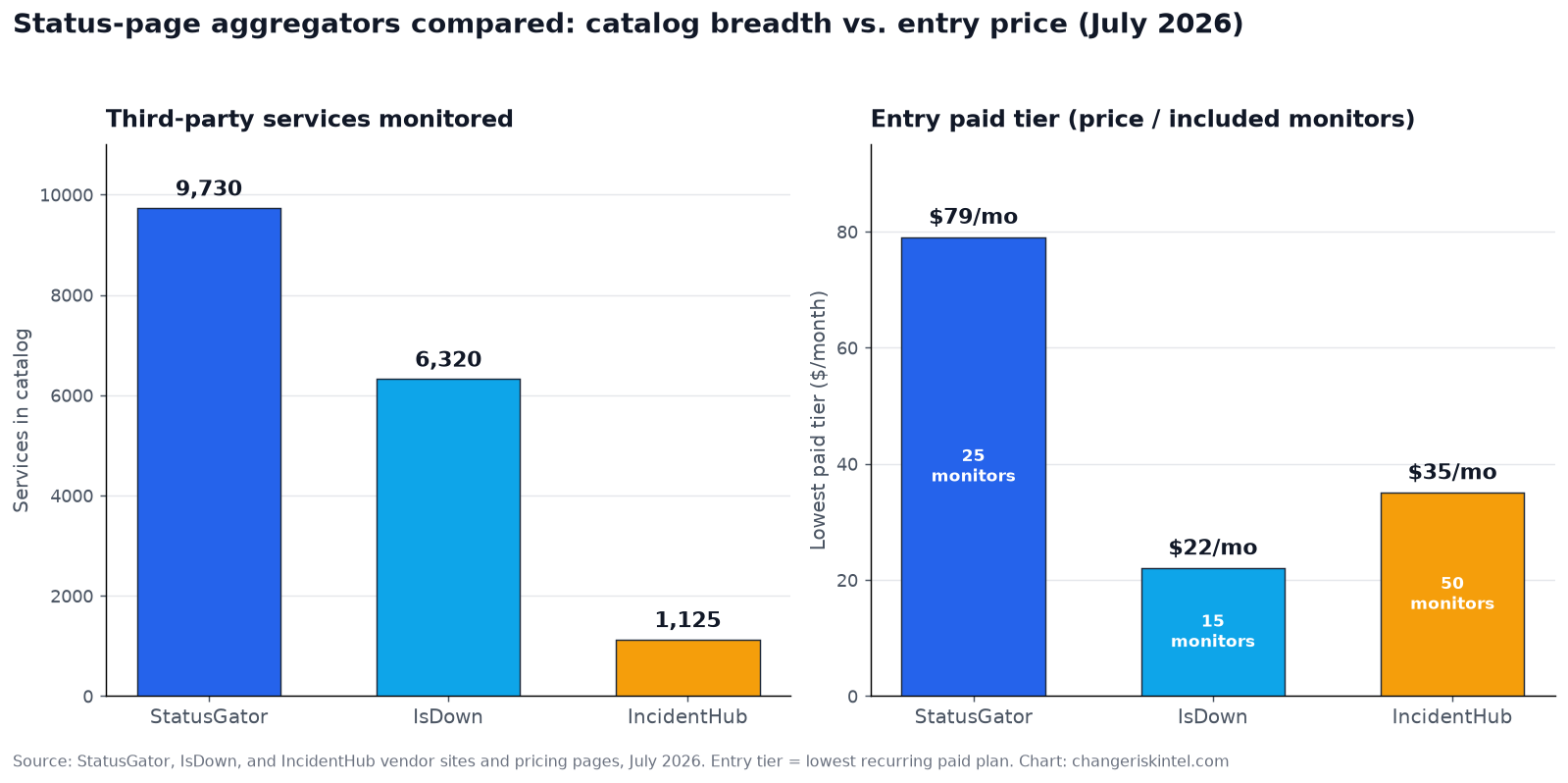
Two things jump out. StatusGator’s catalog is roughly 1.5 times IsDown’s and nearly nine times IncidentHub’s. But catalog breadth and entry price move in opposite directions: the widest catalog carries the highest entry price, while the smallest catalog gives you the most monitored services per dollar at the entry tier. There is no single winner, only a fit for your vendor list and budget.
StatusGator: the broadest catalog, at a price
StatusGator positions itself as the category leader and has the numbers to back the claim. It “collects the status of 9,730+ services such as cloud infrastructure, hosted applications, and SaaS tools,” per the StatusGator homepage. Its signature feature is early detection that does not wait for a vendor to admit fault: “in addition to official outage notices, StatusGator sends you Early Warning Signals when possible outages are detected through crowdsourced reports,” and it claims those signals detect “thousands of outages in advance,” per its aggregator comparison page. It also keeps “10+ years of history for hundreds of providers,” which is genuinely useful when a CAB wants to hold a vendor accountable at renewal.
Pricing scales with the number of services you monitor. The StatusGator plans page lists a free tier for 3 monitors, Starter at $79/month for 25, Team at $149/month for 75, and Corporate at $299/month for 150.
The weakness: StatusGator is the most expensive way into this category, and its per-monitor economics get tight fast. At $79 a month for only 25 monitored services, a mid-sized shop tracking 60 or 70 vendors is pushed into the $149 tier quickly. You pay a premium for the catalog and the crowdsourced signals, and if your vendor list is short, you are subsidizing breadth you do not use.
IsDown: strong detection at a lower entry point
IsDown competes directly with StatusGator on the same “official plus crowdsourced” detection model but undercuts it on entry price. It surfaces “real-time and historical outage data from 6,320+ vendors,” per the IsDown pricing page, and layers crowdsourced problem reports on top of official status feeds for earlier warning. Its plans, from the same page, run Starter at $22/month for 15 monitors, Pro at $40/month for 30, Premium at $80/month for 70, and Business at $150/month for 150, with a 14-day trial and a 10-day money-back guarantee. Notably, IsDown advertises an MCP server and API access even on lower tiers, which matters if you want to wire outage data into your own tooling or an LLM-driven runbook.
The weakness: IsDown’s catalog is meaningfully smaller than StatusGator’s, roughly 6,320 versus 9,730 services. For mainstream SaaS and cloud vendors the gap rarely bites, but if your stack includes niche or regional providers, you are more likely to hit a “not supported” wall. The entry Starter tier also caps you at 15 monitors, so the low headline price climbs once you add a realistic vendor list.
IncidentHub: budget-friendly, MSP-oriented, thinner coverage
IncidentHub is the value play and leans hard toward managed service providers and multi-team setups. It is “the vendor outage monitor and status page aggregator that watches 1125+ third-party services in real time,” per the IncidentHub homepage, alerting your team the moment a critical vendor goes down. Its integration list is broad for the price, covering Slack, Microsoft Teams, PagerDuty, Discord, email, webhooks, and ticketing systems including Jira Service Management, Zendesk, and Freshdesk. Pricing starts at $35/month for the Starter plan (50 monitors, 30-day incident history), $60/month for Pro (100 monitors, 90-day history), $75/month for a Multi-Client plan aimed at MSPs managing up to 50 client status pages, and $90/month for Business with up to 20 independent teams, all from the same homepage.
The weakness: the catalog is the obvious one. At 1,125+ services, IncidentHub tracks less than an eighth of what StatusGator does, so the odds it misses one of your vendors are far higher. Its entry-tier incident history is also short at 30 days, which limits the vendor-reliability trend analysis a CAB wants at renewal time. IncidentHub trades coverage and history for price and team-routing features.
What to do about it
Do not pick on headline catalog size or price alone. Run this sequence before you commit.
- List your critical vendors first. Write down every third-party service whose outage would trigger an incident: cloud, CDN, auth, payments, email, CI/CD, observability. This list, not the marketing page, decides the winner.
- Test the catalog against that list. Sign up for each tool’s free tier or trial and confirm it actually tracks your specific vendors. A tool that misses even one Tier 0 dependency is disqualified regardless of price.
- Count monitors realistically. Your critical-vendor list is almost always longer than an entry tier allows. Price the plan you will actually need, not the cheapest one advertised.
- Route alerts where the CAB already lives. Wire the aggregator into Slack, Teams, or PagerDuty so vendor incidents land in the same channel as your change and incident traffic. An alert nobody sees is not early warning.
- Keep the outage history for renewals. Longer retention lets you show a vendor its own downtime record when you renegotiate. Weigh the history window, not just the live dashboard, especially on cheaper tiers.
- Fold vendor outages into the change record. When an aggregator flags a dependency incident, log it against affected changes so your board learns which vendors keep hurting your delivery. This is the practical follow-through to treating a cloud P1 as provider-of-provider risk.
A free companion for the visualization side: our cloud status heatmap tool gives your CAB a fast at-a-glance read on major-provider health without any subscription, which pairs well with a paid aggregator for the long tail.
The honest trade-off
None of these tools removes the work of deciding what to do when a vendor breaks; they only shorten the time to knowing. StatusGator buys you the widest net and the strongest early-warning signal, and you pay for it. IsDown gives you nearly the same detection model at a lower door price, with a smaller catalog that occasionally shows. IncidentHub is the cheapest, most MSP-friendly option, and its thin catalog and short entry-tier history are the cost of that. Match the tool to your actual vendor list and your CAB’s alerting habits, and the “best” one is simply the one that covers your dependencies and lands in a channel your board will read. For broader platform decisions beyond outage monitoring, our tools and vendor comparisons and our best change management software for regulated industries guide cover the wider stack.
Sources
- StatusGator homepage (9,730+ services, Early Warning Signals, 10+ years history)
- StatusGator plans and pricing
- StatusGator vs. other status aggregators (crowdsourced detection claims)
- IsDown pricing (6,320+ vendors, tier prices, MCP/API)
- IncidentHub homepage (1,125+ services, pricing, integrations)
- Gatling: the cost of downtime in 2026
- CyberSaint: lessons from the AWS outage for third-party risk
Frequently asked questions
Published July 30, 2026.