The 3-Day KEV Clock: A CAB Runbook for CVE-2026-8037
This article is operational change-management guidance for CAB and infrastructure teams, not incident-response or legal advice. Validate remediation steps against the vendor advisory for your deployment. No affiliate links appear below.
Table of contents
- Why a three-day clock breaks a normal change process
- What CVE-2026-8037 actually is
- How three days became the deadline
- Running the emergency change against the clock
- What to do about it
- FAQ
- Sources
Why a three-day clock breaks a normal change process
Most change advisory boards are built for a rhythm measured in weeks. A normal change gets submitted, sits in a queue, waits for a scheduled CAB, collects sign-offs, and lands in a maintenance window. That rhythm assumes the risk of waiting is lower than the risk of moving fast without review.
A CISA Known Exploited Vulnerabilities deadline inverts that assumption. On August 7, 2026, CISA added a critical Progress Kemp LoadMaster flaw to its KEV catalog and set a remediation due date of August 10, 2026 (NVD CVE-2026-8037 record). Three calendar days, one of which was a Sunday. No normal CAB cadence survives contact with that timeline, and the asset in question is not a back-office server. It is a load balancer, the device that fronts your application traffic and terminates TLS.
This is the exact scenario an emergency-change path exists for, and the reason it has to be designed before the clock starts, not improvised while it runs. If your team is still debating who can approve an out-of-band patch on August 8, you have already lost a day of a three-day budget.
What CVE-2026-8037 actually is
CVE-2026-8037 is an OS command injection vulnerability in the API of Progress ADC products, including Progress Kemp LoadMaster. CISA’s catalog entry describes it as allowing “an un-authenticated attacker to execute arbitrary commands on the LoadMaster appliance by exploiting unsanitized input in multiple command endpoints” (NVD CVE-2026-8037 record). It carries a CVSS score of 9.6 in CISA’s listing, with Progress’s own v3.1 assessment reaching 9.8 (The Hacker News report). Its EPSS exploitation-probability score sits at 99.3%, higher than nearly every other scored CVE (OpenCVE CVE-2026-8037 detail).
Two properties make this a crown-jewel problem for a change team. First, no authentication is required: any attacker who can reach the management API can run commands. Second, on LoadMaster the relevant service runs with high privilege, so successful exploitation means control of the appliance, not just a single process (SecureLayer7 technical analysis). A load balancer’s configuration holds backend topology, health-check credentials, and often TLS private keys, which is why a compromised ADC is treated as a breach of everything behind it.
The fix has been available since the original June 2026 advisory. Progress patched the flaw in LoadMaster GA 7.2.63.2 and LTSF 7.2.54.18; vulnerable builds are GA 7.2.63.1 and prior, and LTSF 7.2.54.17 and prior (Progress LoadMaster vulnerabilities documentation). That timing detail is the crux of the whole change-management story: this was not a zero-day sprung on defenders. The patch sat available for over two months before the deadline landed.
How three days became the deadline
The compressed window is a feature of CISA’s newer remediation model, not an accident. On June 10, 2026, Binding Operational Directive 26-04, “Prioritizing Security Updates Based on Risk,” superseded the older BOD 22-01 KEV-remediation directive and its flat 14-day expectation (CrowdSec BOD 26-04 analysis). In its place, BOD 26-04 grades each vulnerability against four binary variables: whether the asset is publicly exposed, whether the CVE is in the KEV catalog, whether exploitation is automatable, and whether exploitation grants total control of the asset. The worst combination maps to a three-calendar-day timeline with mandatory forensic triage.
CVE-2026-8037 hits every one of those variables. It is exploitable over the network, it is now in the KEV catalog, it is automatable through publicly available proof-of-concept code, and it yields total control of the appliance. That is why the KEV entry directs agencies to “apply mitigations in accordance with vendor instructions, ensuring compliance with CISA’s BOD 26-04” and to follow the directive’s forensic-triage requirements (NVD CVE-2026-8037 record).
The exploitation signal was building for weeks before CISA acted. A functional proof-of-concept was released on June 29, 2026, and eSentire’s Threat Response Unit reported active exploitation attempts beginning the same day, originating from a small set of source IPs (eSentire security advisory). Telemetry from KEVIntel later counted 792 exploitation attempts from 65 unique IP addresses across 18 countries over a 41-day window, with the most recent activity on August 4, 2026 (The Hacker News report). Canada’s Cyber Centre also flagged in-the-wild exploitation and echoed the August 7 KEV addition in its advisory (Canadian Centre for Cyber Security AV26-552).
The chart below shows how that timeline collapses. The patch was available for 67 days before the federal deadline, yet the enforced window from KEV listing to deadline was only three of them.
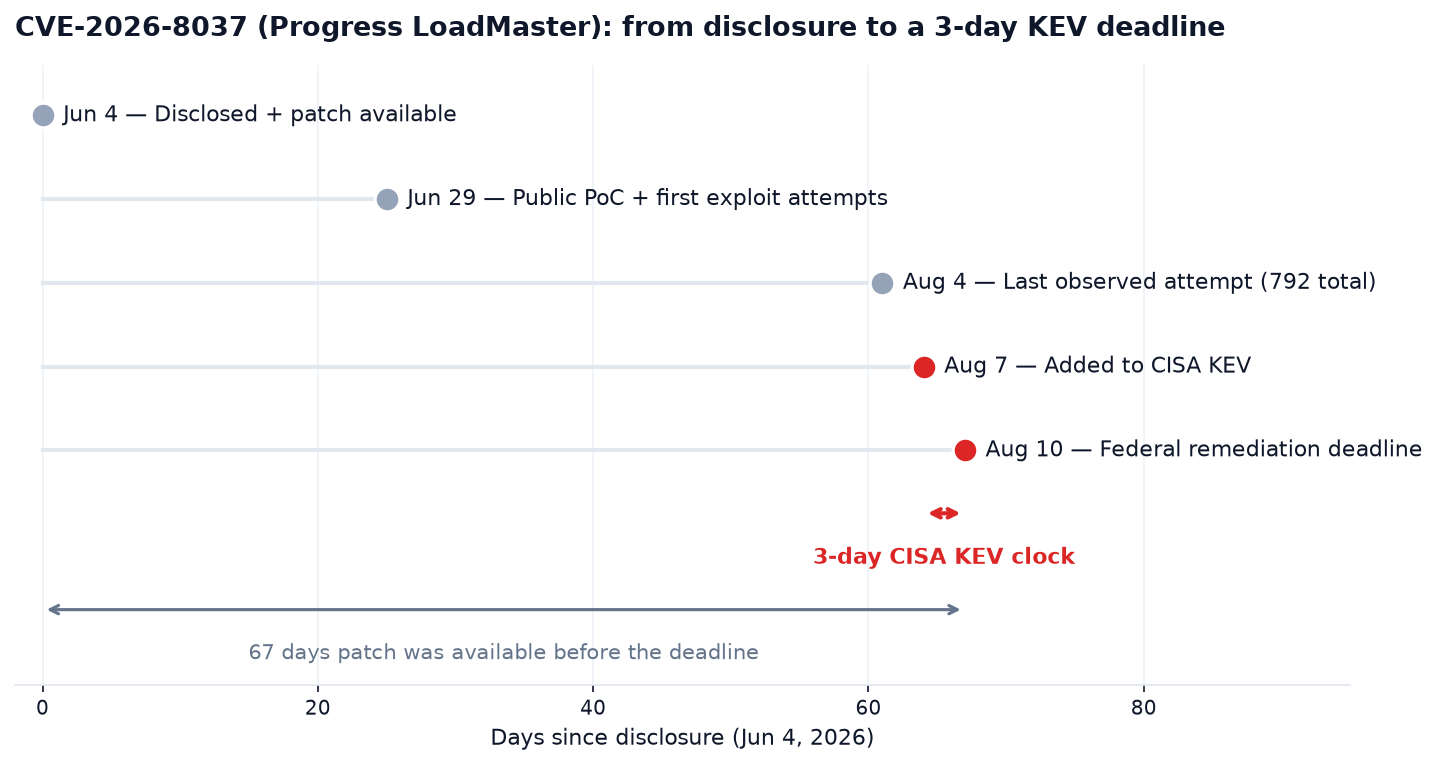
For change leaders the lesson is uncomfortable but clear. Under BOD 26-04, the gap between a patch being available and a patch being mandatory can shrink to almost nothing once exploitation is confirmed. Waiting for the KEV listing to start planning means starting three days late. This is the same dynamic we covered in our CISA BOD 26-04 risk-based remediation guide, and it is why edge-appliance patches now belong on a standing emergency track.
Running the emergency change against the clock
An emergency change is still a change. It skips the queue, not the discipline. The point of a pre-approved emergency path is that the authority, the rollback plan, and the verification steps are agreed in advance, so the only thing happening under the clock is execution. Here is how a CAB should sequence a KEV event like this one.
Trigger and authority. The KEV listing itself is the trigger. Your change policy should name, in advance, who can authorize an emergency change on an internet-facing appliance without waiting for a full board, typically a change manager plus an on-call engineering lead. Record the authorization in the ticket with a timestamp; BOD 26-04’s forensic expectations make your own paper trail an asset later.
Hunt before you patch. Patching removes the vulnerability, not an intruder who already used it. Before upgrading, preserve the appliance logs and review management-interface access for injection-pattern requests going back at least 30 days. Because any exposed LoadMaster should be treated as potentially probed, credential and key rotation belongs in the plan if you find anything (threat.wiki CVE-2026-8037 operations note).
Reduce exposure immediately. The single most effective interim control is removing the management API and web UI from any internet-reachable path, restricting them to a management VLAN or jump host. That neutralizes unauthenticated remote exploitation even before the patch lands, which buys the change window some breathing room.
Patch with failover, not a maintenance window. LoadMaster supports clustered failover, so the upgrade to GA 7.2.63.2 or LTSF 7.2.54.18 can often be done node by node without downtime. Verify the running version in the web UI after the upgrade rather than assuming the job succeeded. Score the whole thing before you execute it with our change risk score tool so the emergency ticket still carries a defensible risk rating.
Verify and close. The change is not done when the patch is applied. It is done when you have confirmed the fixed version is running, the management interface is no longer exposed, log forwarding to your SIEM is active, and the forensic review came back clean or triggered an incident case. Only then does the ticket close against the deadline.
Run a scoped CAB agenda for the retrospective, not the emergency itself. The board’s job after the fact is to ask why a two-month-old patch was still unapplied when the KEV clock started, and to feed that answer back into the standing emergency path.
What to do about it
- Inventory every LoadMaster and ADC instance now, including virtual appliances, cloud images, disaster-recovery copies, and partner-accessible systems. KEV events routinely surface forgotten or shadow appliances.
- Determine whether the management API is enabled and reachable. If it is exposed on a vulnerable build, treat that instance as an emergency patch and exposure-reduction candidate today.
- Preserve logs and hunt before patching. Export management-interface access logs and check for injection-pattern requests over the past 30 days before you upgrade.
- Upgrade to GA 7.2.63.2 or LTSF 7.2.54.18 using clustered failover to avoid downtime, and verify the running version afterward.
- Restrict the WUI and API to a management network, and confirm at the perimeter firewall that no internet ingress path to the appliance exists.
- Rotate credentials and TLS keys stored on any appliance where compromise cannot be ruled out.
- Retrospect the lead time. Bring the whole event to your next CAB and formalize a KEV-triggered emergency-change fast lane so the next three-day clock is a rehearsed process, not a scramble. See our change-management pillar for the surrounding playbooks.
FAQ
What is the remediation deadline for CVE-2026-8037? CISA set a federal remediation due date of August 10, 2026, three days after adding the vulnerability to its KEV catalog on August 7, 2026 (NVD CVE-2026-8037 record).
Which LoadMaster versions are affected and which are fixed? Vulnerable builds are GA 7.2.63.1 and prior, and LTSF 7.2.54.17 and prior. Progress fixed the flaw in GA 7.2.63.2 and LTSF 7.2.54.18 (Progress LoadMaster vulnerabilities documentation).
Do private-sector organizations have to meet the August 10 deadline? The BOD 26-04 deadline is binding only on U.S. Federal Civilian Executive Branch agencies. CISA encourages all organizations to treat KEV due dates as a prioritization signal, and given confirmed active exploitation, the same deadline is a reasonable internal SLA for any exposed instance (CrowdSec BOD 26-04 analysis).
Is CVE-2026-8037 being actively exploited? Yes. A public proof-of-concept appeared on June 29, 2026, eSentire observed exploitation attempts the same day, and external telemetry counted 792 attempts from 65 IPs across 18 countries before the KEV listing (eSentire security advisory, The Hacker News report).
Why did CISA give only three days instead of the old two-week KEV window? BOD 26-04, which took effect June 10, 2026, replaced the flat 14-day KEV expectation with a risk-based model. A vulnerability that is publicly exposed, KEV-listed, automatable, and grants total asset control gets the top-tier three-day timeline with mandatory forensic triage (CrowdSec BOD 26-04 analysis).
Can I patch LoadMaster without downtime? Usually yes. LoadMaster supports clustered failover, so most teams can upgrade node by node without a service outage, which removes the argument for waiting on a maintenance window under a KEV clock.
Sources
- NVD — CVE-2026-8037 detail
- Progress — LoadMaster vulnerabilities documentation
- Canadian Centre for Cyber Security — Progress advisory AV26-552
- eSentire — Progress Kemp LoadMaster vulnerability targeted (CVE-2026-8037)
- The Hacker News — LoadMaster flaw hits CISA KEV after 792 reported exploit attempts
- CrowdSec — CISA BOD 26-04 analysis
- OpenCVE — CVE-2026-8037 detail
- SecureLayer7 — CVE-2026-8037 technical analysis
- threat.wiki — CVE-2026-8037 pre-auth RCE operations note
Published August 10, 2026.