Microsoft Risk Cohorts as a CAB Intake Template
No affiliate links appear in this article. CVE counts come from Microsoft’s CVRF data for the November 2026 release, linked in Sources. The cohort assignments are ChangeRiskIntel’s own mapping of Microsoft component tags to the example cohorts MSRC published, not an official Microsoft grouping.
Table of contents
- Why this matters
- What does MSRC actually offer?
- What goes in a cohort intake record?
- What did November look like when sorted into cohorts?
- Three filled-in records from November
- Where does the cohort approach break?
- What to do about it
- FAQ
- Sources
Why this matters
Microsoft’s November release published 1,093 Microsoft-assigned CVEs on November 10, the second month in a row above 1,000. Our November Patch Tuesday CAB plan covered what shipped and which items belonged on the emergency track. This piece is about the paperwork side of that plan: what a change advisory board actually records so the same environment questions don’t get answered from scratch every month.
MSRC suggested the unit of work in October. Its risk cohorts post groups CVEs that “require a similar customer assessment,” even when they share no root cause or CVSS score. A month later, the Windows Server team’s risk-based patching guidance described three response paths (routine, accelerated and emergency) and said each one needs defined owners, approvals, stop criteria and evidence. Put the two together and you get a change intake record: one per cohort, with an answer, a path and an owner.
The template below is built for that. It also deals with the parts MSRC leaves open: the Security Update Guide doesn’t show cohorts, so you build them yourself, and some CVEs don’t fit the cohort their component name suggests.
What does MSRC actually offer?
The October post lists 15 example cohorts, each with a shared question. The remote-access cohort, for example, asks “Which hosts act as clients, gateways or remote-access servers, and which access paths and identities are permitted?” MSRC then suggests a five-step loop: group CVEs by shared question, answer each question once and document it, use the answer as a starting point, keep prioritizing individual CVEs on exploitation, severity, attack vector, privileges and user interaction, and check whether the approach hides exceptions.
MSRC is clear about the limits. The cohorts are “provisional customer-risk groupings.” They “are not official Microsoft vulnerability categories, do not change Microsoft update guidance.” A cohort “does not mean that one update, workaround, or mitigation addresses every CVE in the group.” And “the Security Update Guide (SUG) does not currently display these relationships.” Microsoft says it isn’t committing to a product integration.
In practice, that means no cohort field in the CVRF API and no cohort column in the Security Update Guide export. What you do get per CVE is a component tag, a severity rating, an exploitability assessment, a CVSS vector and a customer-action flag. Those are enough to build cohorts and to flag the exceptions.
What goes in a cohort intake record?
One record per cohort per release. Most fields carry over from month to month. The answer gets re-checked, the CVE list is replaced, and the path is decided again.
| Field | What goes in it | Where the answer comes from |
|---|---|---|
| Cohort and shared question | MSRC’s wording where a cohort exists; your own for cohorts you add | MSRC risk cohorts post |
| CVEs in scope | Count and list for this release, grouped by component tag | CVRF document or SUG export |
| Environment answer | Yes, no or partial, in one or two sentences | CMDB query, server inventory, firewall rule review |
| Evidence and date | The query or report used, who ran it, when | Saved query or report link |
| Exposed assets | Counts by exposure: internet-facing, reachable from less-trusted networks, internal only, none | Inventory joined with network exposure data |
| Pulled-out CVEs | Any CVE that is exploited, rated Critical, scored CVSS 9.0 or higher, or reachable over the network with no privileges and no user interaction | CVRF threats and CVSS vectors, plus the CISA KEV catalog |
| Cross-cohort flags | CVEs whose real exposure sits in another cohort | CVE FAQ text and product team posts |
| Response path | Routine, accelerated or emergency, and the target date | Your policy; Windows Server guidance |
| Ring plan and stop criteria | Pilot systems, ring order, health checks, what halts the rollout | Your deployment rings definition |
| Rollback and known issues | Uninstall path, snapshot or backup, documented known issues | Release notes and product team posts |
| Compensating controls | Temporary mitigations, each with an owner and an expiry date | Vendor guidance; your compensating controls register |
| Owner and approver | Who answered, who accepts the path, review date | Change record |
Two fields need a rule, not judgment. The pulled-out filter has to be mechanical, or cohorts turn into a way to defer things nobody looked at. And compensating controls need an expiry date. The Windows Server guidance says those controls “are not substitutes for remediation” and should each have “an owner, an expiration or review point, and a tracked plan” for the permanent update.
What did November look like when sorted into cohorts?
We took the 1,093 Microsoft-assigned CVEs first published on November 10 from Microsoft’s November CVRF document and mapped their 287 component tags to MSRC’s 15 example cohorts. Two groups didn’t fit any of MSRC’s examples, so we added them: server applications (SQL Server, SharePoint, Exchange, IIS) and developer tools, SDKs and cloud services. Then we applied the pulled-out filter.
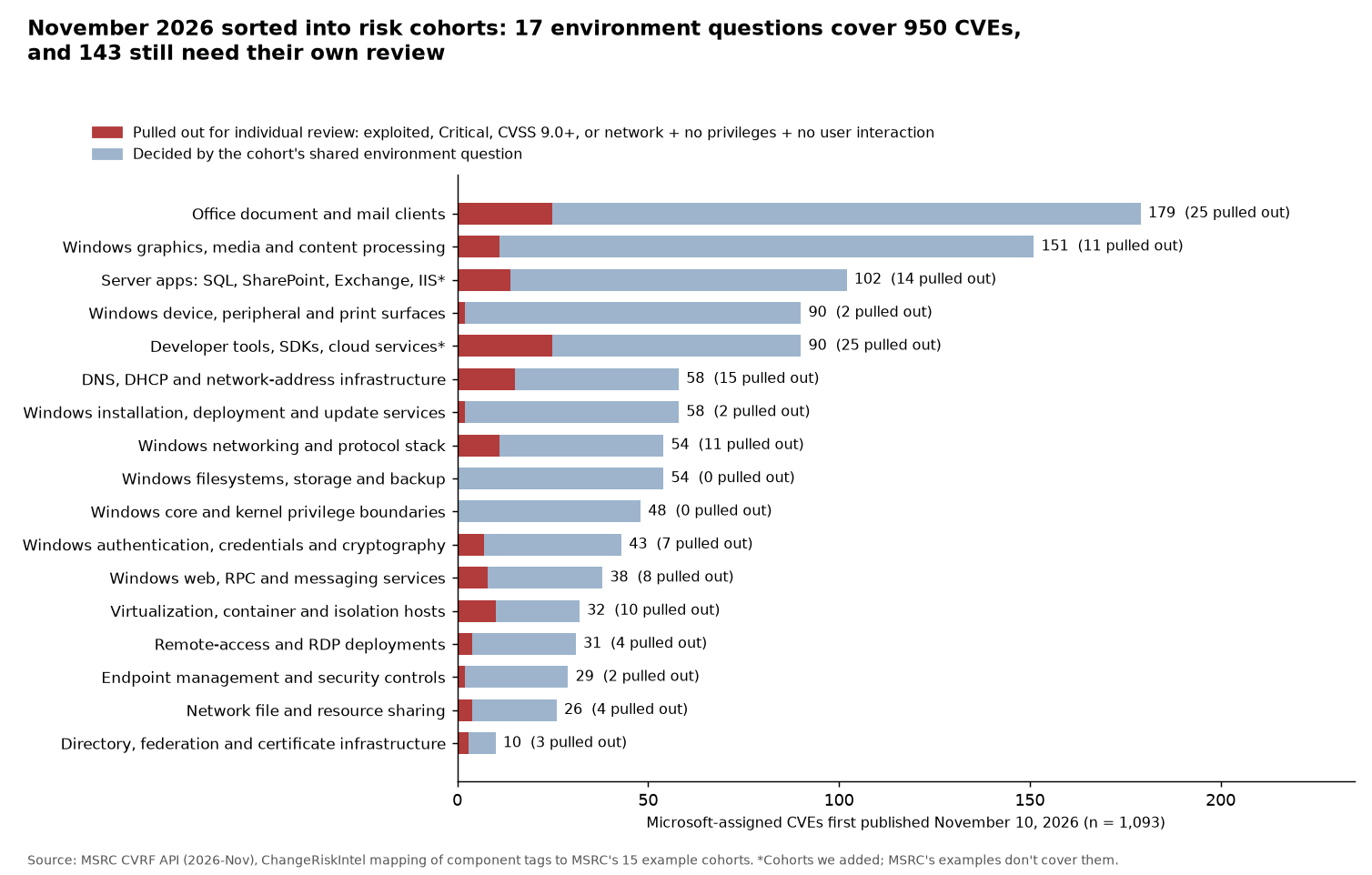
The result: 17 environment questions cover 950 CVEs, and 143 still need an individual look. The pulled-out share varies a lot by cohort. Filesystems and kernel privilege boundaries had none, so their records come down to the answer and the normal path. Developer tools and DNS/DHCP had the highest shares, because many of their CVEs are network-reachable with no privileges.
A second finding matters for the filter design. Of the 23 November CVEs scored CVSS 9.0 or higher, Microsoft rated only 4 as Critical. The other 19 were rated Important, including Windows DNS (CVE-2026-88218), Windows DHCP Server (CVE-2026-88243), SQL Server (CVE-2026-116945) and Windows Kerberos (CVE-2026-85844), each with a 9.8 network, no-privilege, no-interaction vector. A filter that pulls out only Microsoft-rated Critical CVEs would leave all four inside their cohorts. That’s why the template’s filter includes the score and the vector, not just the severity label. The FIRST CVSS v3.1 specification defines those vector fields.
Three filled-in records from November
These are abbreviated. A real record would also carry the evidence links and asset counts from your own inventory.
Remote-access and RDP deployments (31 CVEs in our mapping)
- Question: MSRC’s, as quoted above. In practice: do we run RD Gateway or RD Session Host reachable from outside, and do managed devices connect out over RDP?
- Pulled out (4): CredSSP RCE CVE-2026-119962 (Critical, network, no privileges, no interaction, high attack complexity); Remote Desktop Services EoP CVE-2026-119957 (Critical, local); two network denial-of-service bugs in SSTP (CVE-2026-105561) and Remote Desktop (CVE-2026-119932).
- Path: If RD Gateway is internet-facing, accelerated for the gateway and session hosts, with CredSSP reviewed on its own. If RDP is reachable only through VPN or a Zero Trust access path, MSRC itself says some cohort CVEs “may be lower priority for immediate action,” so routine.
Server applications: SQL, SharePoint, Exchange, IIS (102 CVEs)
- Question: Which of these run on premises, on which versions, and which are reachable from the internet or by email?
- Unsupported versions: The November Exchange security update post ships updates for Exchange SE only and says Exchange 2016 and 2019 should be considered “permanently vulnerable.” An answer of “yes, we still run 2019” doesn’t belong on a patch path. It’s a separate risk acceptance or migration change.
- Cross-cohort flag: Windows Search RCE CVE-2026-116928 (CVSS 9.8, Critical) is tagged to the Windows Search component, so a tag-based mapping puts it in the content-processing cohort. Its Security Update Guide entry says an attacker can exploit “the Windows Search component used by Microsoft Exchange Server” with a crafted attachment that Exchange indexes automatically, so “the recipient does not need to open the email or attachment.” Its real exposure question is the Exchange one.
- Dependency: The same Exchange post says the instability some Exchange servers saw after October’s Windows updates is fixed by November’s Windows Server updates, not by the Exchange update. The record should link the two changes.
- Other pulled-out items: SQL Server RCE CVE-2026-116945 (9.8, rated Important) and Exchange RCE CVE-2026-118207 (Critical, low privileges).
Office document and mail clients (179 CVEs)
- Question: Which users and devices open untrusted documents or mail, on which Office channels, and how fast do Office updates reach them?
- Pulled out (25): All 22 Critical Office CVEs require user interaction, so they ride with the cohort answer, but on an accelerated path. The exploited Outlook spoofing flaw, CVE-2026-124194, is rated Moderate at CVSS 6.5. It’s still the most urgent item of the month because it’s on the CISA KEV catalog with a November 24 due date. Exploitation status beats both severity and cohort.
- Path: Emergency for the Outlook KEV item, accelerated for the rest of the cohort. Track the KEV clock on our CISA KEV live tracker.
Where does the cohort approach break?
- It isn’t in Microsoft’s data. There is no cohort field, so every team maintains its own mapping. That mapping drifts as Microsoft adds component tags. November alone had 287.
- Component tags mislabel exposure. The Windows Search case above is the clearest November example. Cross-cohort flags come from reading FAQ text, which doesn’t scale without someone owning it.
- Severity labels understate network risk. 19 of 23 CVEs scored 9.0 or higher were rated Important. A cohort process that trusts the label will defer them.
- Answers go stale. “No internet-facing RD Gateway” is true until someone publishes one. Answers need a date and a recheck each release, not a standing exemption.
- MSRC’s examples skip server apps and dev tools. In November those two groups held 192 CVEs and 39 of the 143 pulled-out items. Add them yourself.
- A shared question doesn’t mean a shared fix. MSRC says so directly. The ring plan still has to cover each update package.
What to do about it
- Create one intake record per cohort. Start with MSRC’s 15, add server applications and developer tools, and keep the shared question wording stable so answers carry over.
- Make the pulled-out filter mechanical. Exploited, KEV-listed, Critical, CVSS 9.0 or higher, or network plus no privileges plus no user interaction. Anything that matches gets individual review, whatever its cohort answer says.
- Date every answer. Re-run the inventory query each release and record who ran it. A stale answer counts as a finding.
- Assign the path in the record. Use routine, accelerated and emergency, as the Windows Server guidance describes, and connect the emergency path to your BOD 26-04 decision matrix for KEV items.
- Treat unsupported versions as their own change. Exchange 2016 and 2019 answers go to risk acceptance or migration, not to the patch ring.
- Keep the monthly view in one place. Our Patch Tuesday calendar shows release dates, and the change risk score tool can carry each cohort’s exposure answer into the change’s score. For how scores sequence work inside the KEV gate, see our vulnerability prioritization comparison. For deferral evidence auditors accept, see risk-based patching audit defensibility. More templates live on the change management hub.
FAQ
What are Microsoft risk cohorts?
They are groups of CVEs that need the same assessment of your environment, such as whether you expose an RD Gateway. MSRC proposed them on October 13, 2026 as provisional, unofficial groupings. They don’t change Microsoft’s update guidance and aren’t shown in the Security Update Guide.
Does the Security Update Guide show cohorts?
No. MSRC says the Security Update Guide does not currently display cohort relationships and that it isn’t committing to a product integration. You build cohorts from component tags, CVSS vectors and FAQ text in the CVRF data or the SUG export.
Which CVEs should skip the cohort answer?
Pull out any CVE that is exploited or KEV-listed, rated Critical, scored CVSS 9.0 or higher, or reachable over the network with no privileges and no user interaction. In November 2026 that rule pulled out 143 of 1,093 Microsoft CVEs.
How many cohorts did November 2026 need?
In our mapping, 17: MSRC’s 15 example cohorts plus server applications and developer tools. Office document and mail clients was the largest at 179 CVEs, and directory, federation and certificate infrastructure was the smallest at 10.
Sources
- MSRC: Using risk cohorts to prioritize security updates (October 13, 2026)
- Microsoft Windows Server Blog: Building a risk-based patching response for Windows Server (November 2, 2026)
- MSRC CVRF API: November 2026 security updates document
- MSRC Security Update Guide: November 2026 release notes
- Microsoft on GitHub: MSRC Microsoft Security Updates API
- MSRC Security Update Guide: CVE-2026-116928 Windows Search Remote Code Execution Vulnerability
- Microsoft Exchange Team: Released: November 2026 Exchange Server Security Updates
- CISA: Known Exploited Vulnerabilities Catalog
- FIRST: CVSS v3.1 Specification Document
Published November 23, 2026.