N-able N-central KEV: When the Emergency Patch Is Incomplete
This article covers defensive change-management and remediation actions only. It contains no exploitation detail. Some vendor links below are informational, not affiliate links.
Why this matters
On August 3, 2026, CISA added an N-able N-central authentication bypass to its Known Exploited Vulnerabilities catalog, and set a remediation deadline of August 6 for federal civilian agencies (CISA KEV addition, via The Register). Three days is unusually short. It is the accelerated timeline CISA reserves under Binding Operational Directive 26-04 for vulnerabilities it judges an urgent, active risk, rather than the standard two-week window.
The reason for the urgency is the product. N-central is a remote monitoring and management (RMM) platform that managed service providers use to administer thousands of downstream customer endpoints from a single console. An authentication bypass on that console is the keys to the kingdom. But the detail that makes this a change-management case study, not just a patch-now alert, is what happened between the first fix and the second: N-able shipped a patch, believed the issue closed, and then found attackers were still getting in. The remediation everyone had already applied was incomplete.
What actually happened, in change terms
The timeline matters because it explains why a team that “patched last week” may still be exposed today.
CVE-2026-18556 is an authentication bypass using an alternate path or channel (CWE-288) affecting N-central through version 2026.1, published by NVD on August 1, 2026 (NVD entry for CVE-2026-18556). N-able originally treated version 2026.2, released back on April 28, 2026, as the fix for it (ThreatLocker analysis). For a change team, that is a closed ticket: patch applied, version advanced, risk retired.
Then the assumption broke. N-able determined the original fix left another route to the same outcome, and that this second route was being exploited in the wild. That follow-up issue is tracked as CVE-2026-18577, and Rapid7 describes it plainly as an incomplete patch for CVE-2026-18556 that allows authentication bypass and account takeover in N-central versions through 2026.3.1 (Rapid7 vulnerability entry for CVE-2026-18577). Rapid7’s threat report notes exploitation was observed in the wild beginning around August 1, 2026 (Rapid7 exploitation analysis).
The working fix is N-central 2026.3.1 Hotfix 1, build number 2026.3.1.7, released August 2, 2026. N-able’s own status page is explicit that this hotfix is built on the 2026.3.0 release from July 30 and that it is the first build not affected by CVE-2026-18577 (N-able status page for the 2026.3.1.7 hotfix). The change-management trap is visible in that sentence: the base 2026.3 release is not enough, and neither was 2026.2. Only the specific build 2026.3.1.7 closes the door. A team that recorded “upgraded to 2026.3” as done still has the vulnerability.
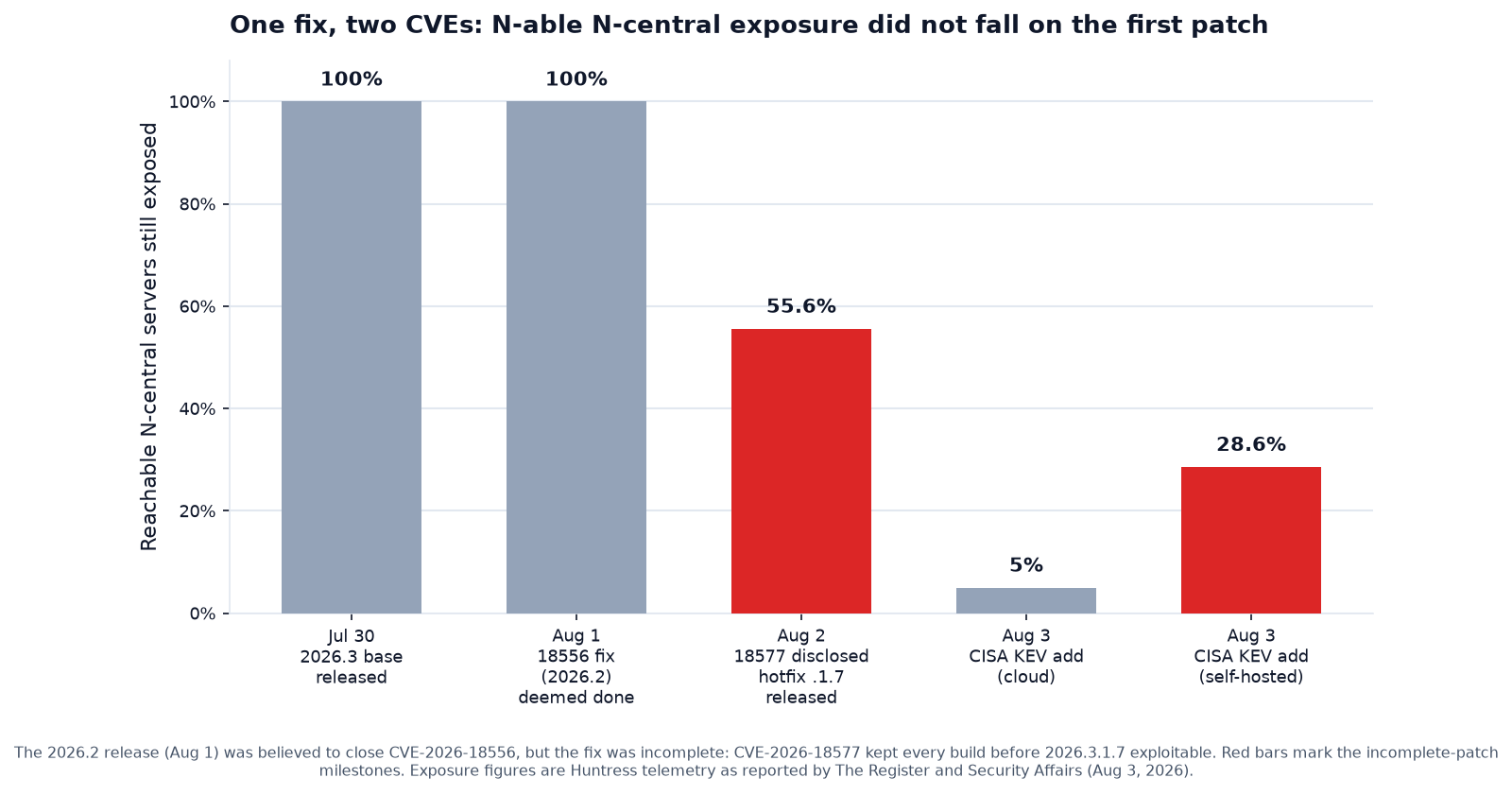
Huntress telemetry, reported by The Register, put the scale of the residual exposure in numbers: even after the hotfix landed, a large share of reachable N-central servers remained unpatched, and by August 3 roughly 28.6 percent of observed self-hosted servers were still vulnerable and exposed to the internet, while nearly all cloud-hosted instances had been remediated (The Register on Huntress data). Security Affairs cited an earlier Huntress figure that 55.6 percent of reachable cloud servers were still unpatched shortly after disclosure (Security Affairs). Self-hosted deployments, which require the operator to apply the hotfix manually rather than receive it automatically, lagged the most.
What the attackers did after the bypass
The change relevance of the post-exploitation behavior is that it tells you what to hunt for before you close the ticket, and why “just patch it” is insufficient once a server was reachable during the exposure window.
According to N-able’s status page and Rapid7’s analysis, attackers who gained administrative access used N-central’s built-in Take Control feature to reach managed endpoints, then established persistence by installing a Cloudflare Tunnel (the cloudflared service) so they could return even after the N-central server itself was patched (N-able status page). The vendor’s stated indicators of compromise include a suspicious svchost.exe file inside a user’s Documents folder, a registered service named Cloudflared, and inbound firewall connections from a specific set of IP addresses the advisory lists.
That persistence mechanism is why a change team cannot treat the hotfix as the end of the work. If an N-central console was internet-reachable during the exposure window, applying 2026.3.1.7 removes the front door but does not evict an attacker who already walked through it and left a tunnel behind. The remediation change and the compromise-assessment change are two separate work items.
The incomplete-patch problem for change control
Most change processes are built around a clean model: a vulnerability is disclosed, a fixed version is named, you deploy it, you close the record. This incident breaks that model in a way worth generalizing beyond N-able, because incomplete fixes are not rare. A vendor ships a patch under time pressure, it addresses the reported path, and a researcher or an attacker finds a parallel path the fix never touched.
For a change advisory board, the failure mode is trusting the version family instead of the exact build. “We’re on 2026.3” reads as patched, when only 2026.3.1.7 is. The discipline this incident argues for is verifying remediation against the precise fixed build number the vendor names as first-safe, and keeping the change record open until that specific number is confirmed in production. It is also an argument for not auto-closing an emergency change on deployment. The record should stay open through a verification step that confirms the deployed artifact actually matches the fixed build, because a patch that was superseded by an incomplete-fix follow-up looks identical in a change log to one that worked.
This is the same reasoning behind CISA’s risk-based remediation model, which we broke down in our analysis of BOD 26-04 and risk-based remediation for CABs: the deadline attaches to closing the risk, not to the act of deploying something. If your first deploy did not close the risk, the clock did not stop.
What to do about it
If your organization runs N-central, or manages a vendor that does, treat this as an active emergency change and work these steps in order.
- Confirm the exact build, not the version family. Verify every N-central server is running build 2026.3.1.7 or later, per N-able’s hotfix advisory (N-able status page). Record the literal build string in the change ticket. A server on 2026.3 or 2026.2 is not remediated.
- Take exposed consoles off the open internet first. If a server is still reachable from untrusted networks and cannot be patched immediately, restrict or disable access to the management console before anything else. Because the bypass requires no credentials, multi-factor authentication does not stop it, so network reachability is the control that matters.
- Re-open, do not re-file, the emergency change. If you already logged a remediation for CVE-2026-18556, re-open that record rather than treating CVE-2026-18577 as unrelated. Score the re-remediation with our change risk score tool so it carries the emergency rating it deserves, and structure the review with our CAB agenda generator.
- Run a compromise assessment for any server reachable during the window. Hunt for the vendor-listed indicators: a
Cloudflaredservice, asvchost.exein a user’s Documents folder, and the IP addresses in N-able’s advisory. If any appear, engage incident response and contact N-able support, and treat downstream managed endpoints as potentially reached through Take Control. - Reset the remediation clock to the working fix. Date your KEV remediation from the deployment of 2026.3.1.7, not from the earlier failed patch. For federal teams the BOD deadline is August 6; private organizations should apply the same urgency given active exploitation.
- Extend the review to your MSP relationships. If a managed service provider administers your environment through N-central, ask them for written confirmation of the build number and the compromise-assessment result. Their console is a path into your network.
For the mechanics of reading a KEV entry and turning it into a change record, see our guide on how to read a CISA KEV entry, and track live additions with our CISA KEV live tool. This N-central flaw was one of three CVEs CISA batched into KEV in early August, alongside an IBM Langflow code-injection flaw and an Apache Tomcat encryption bypass, a pattern we walked through in our four-CVE KEV batch triage for CABs.
Frequently asked questions
What is CVE-2026-18577 in N-able N-central? It is an authentication bypass caused by an incomplete fix for CVE-2026-18556, letting an unauthenticated remote attacker take administrative control of the N-central console. It affects all builds before 2026.3.1.7 and was added to CISA’s KEV catalog on August 3, 2026.
Which N-central version fixes the vulnerability? Build 2026.3.1.7, released August 2 as 2026.3 Hotfix 1, is the first not-affected version. The base 2026.3 and the earlier 2026.2 do not fully close the issue.
Why does an incomplete patch matter for change management? It means a change record that reads as closed is actually still open. Trusting the version family instead of the exact fixed build, or auto-closing on deployment, can leave the vulnerability live while the log says remediated.
How do I know if an N-central server was compromised? N-able’s advisory lists indicators including a Cloudflared service, a svchost.exe in a user’s Documents folder, and specific inbound IP addresses. Any server reachable during the window needs a compromise assessment, not just the patch.
Why did CISA give only three days to remediate? BOD 26-04 lets CISA impose a three-day deadline on vulnerabilities it judges an urgent, actively exploited risk. An unauthenticated takeover of a widely used RMM platform meets that bar.
Does multi-factor authentication protect against this flaw? No. It is an authentication bypass requiring no credentials, so MFA does not help. Restricting network access to the console is the interim control.
Sources
- CISA KEV addition and three-day deadline (The Register)
- NVD entry for CVE-2026-18556
- Rapid7 vulnerability entry for CVE-2026-18577
- Rapid7 exploitation analysis and IoCs
- N-able status page for the 2026.3.1.7 hotfix
- Security Affairs on the KEV add and Huntress exposure data
- ThreatLocker analysis of the N-central bypass
- Canadian Centre for Cyber Security advisory AV26-769
For more change-safety analysis of exploited vulnerabilities, see our cybersecurity pillar.
Published August 5, 2026.