VMSA-2026-0006: A vCenter Emergency-Change Playbook
Why this matters right now
On July 29, 2026, Broadcom published VMSA-2026-0006, an advisory rated Critical covering five vulnerabilities in VMware ESX, vCenter, Workstation, and Fusion. Two of them sit at the top of the severity scale and land squarely on the piece of infrastructure a change advisory board least wants to touch on short notice: the virtualization management plane.
Here is the awkward part for change governance. As of publication, Broadcom says it has no evidence of exploitation in the wild, and no public proof-of-concept exists. None of these CVEs is on CISA’s Known Exploited Vulnerabilities catalog. Under a deadline-driven model like the old flat KEV clock, or even the newer risk-based tiers, an unexploited, non-KEV flaw does not automatically trip the shortest deadline. Yet the technical facts (unauthenticated, network-reachable, total control of vCenter, no workaround) describe exactly the kind of change most CABs would rather not defer to the next monthly window. This advisory is a test of whether your emergency-change path is driven by evidence of attack or by exposure to attack.
What VMSA-2026-0006 actually contains
The advisory bundles five CVEs. Three are the ones that should reach your CAB.
- CVE-2026-59309 — vCenter authentication bypass (CVSS 9.8). A flaw in the VMware Directory Service (vmdir), the identity component behind vCenter Single Sign-On, lets a remote attacker with only network access bypass authentication and reach the vCenter management plane. Per Rapid7’s analysis, no credentials, privileges, or user interaction are required. The vector string is
CVSS:3.1/AV:N/AC:L/PR:N/UI:N/S:U/C:H/I:H/A:H, per its NVD entry. - CVE-2026-59310 — vCenter Syslog directory traversal RCE (CVSS 9.8). A path-traversal flaw (CWE-22) in the vCenter Syslog server allows a network attacker to escape the logging directory and execute arbitrary code, confirmed at CVSS 9.8 by its NVD record.
- CVE-2026-47876 — ESXi VMXNET3 VM escape (CVSS 9.3). An out-of-bounds write in the VMXNET3 virtual network adapter lets an attacker who already holds local administrator rights inside a guest VM break isolation and execute code on the ESX host, per Tenable’s advisory. It was reported through Trend Micro’s Zero Day Initiative at Pwn2Own, per SOC Prime. VMs using non-VMXNET3 adapters are not affected by this path.
The remaining two — CVE-2026-41703 (out-of-bounds read, CVSS 7.6) and CVE-2026-41709 (insufficient logging) — are lower severity but relevant: the logging flaw means a successful intruder may generate fewer audit records, which matters when you scope a compromise assessment.
Why “not yet exploited” is the wrong thing to wait for
The strongest argument for an emergency change here is not fear; it is history. Critical vCenter flaws have a consistent record of moving from disclosure to active exploitation, and the interval is often short.
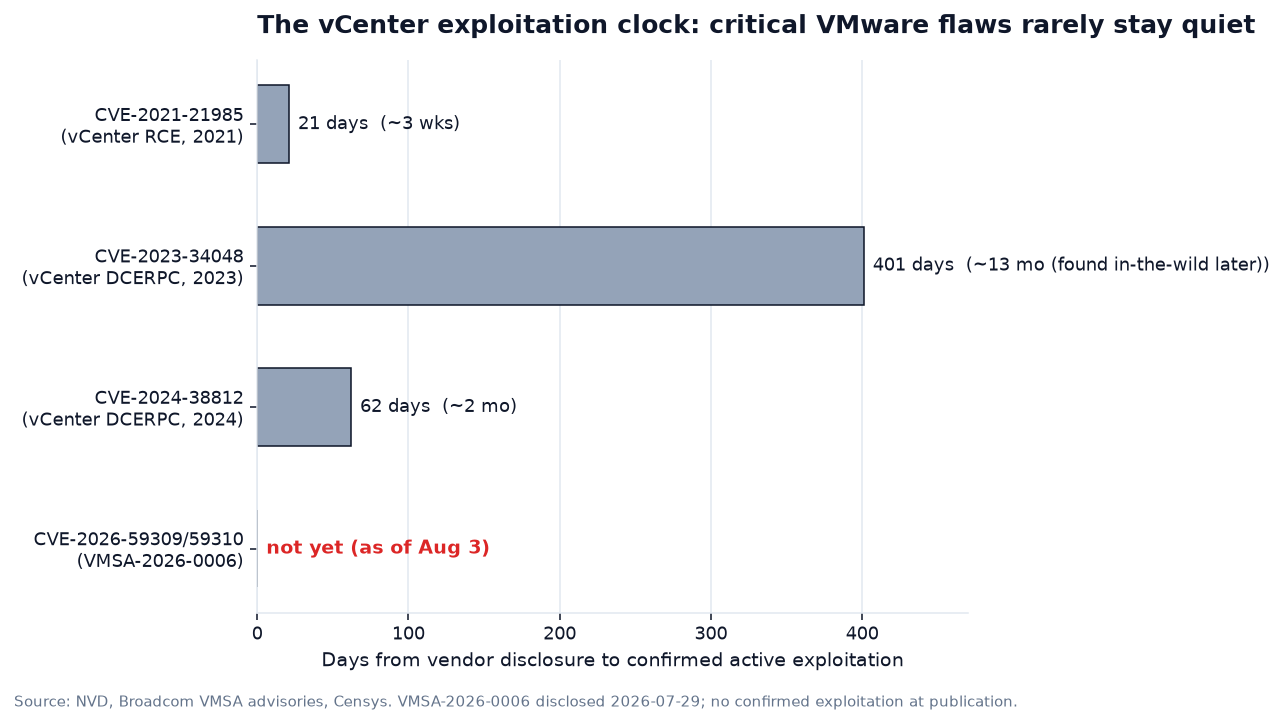
The most instructive precedent is CVE-2024-38812, a CVSS 9.8 vCenter flaw disclosed September 17, 2024. Broadcom confirmed active exploitation on November 18, 2024, about two months later, and CISA added it to the KEV catalog on November 20, 2024, per Censys’s advisory. A CAB that had waited for KEV status before acting would have had roughly nine weeks of exposure on an internet-adjacent management plane. CVE-2023-34048, another vCenter flaw, was patched and only later found to have been exploited in the wild for over a year before disclosure, a reminder that “no evidence of exploitation” is a statement about what defenders have observed, not proof of safety.
For VMSA-2026-0006, the ingredients that historically shorten that clock are all present: two of the three critical flaws are remotely exploitable without authentication, vCenter is a high-value target that security researchers and ransomware crews actively hunt, and there is no workaround to buy time. The rational change posture is to assume the exploitation window is opening, not to wait for confirmation that it already has.
The management plane makes this a change-risk problem, not just a patch
A vCenter patch is not a routine endpoint update, and treating it like one is where change management earns its keep. Three properties raise the blast radius.
First, vCenter is the control plane for everything it manages. A compromise of vmdir via CVE-2026-59309 hands an attacker the console that controls virtual machines, clusters, snapshots, backups, and often the credentials wired into them, as Socura’s breakdown of the attack chain describes. The change you are approving protects the single system whose loss is hardest to recover from.
Second, patching it has real availability cost. The vCenter appliance update requires a service restart, and the ESXi fix for CVE-2026-47876 requires a host reboot. Broadcom’s guidance, summarized by SOC Prime, is to relocate workloads with vMotion and patch clusters through a rolling reboot, with ESX Live Patch available for some source-to-target build combinations to reduce disruption. That is a genuine change with downtime implications for hosted workloads — exactly the trade-off a CAB exists to weigh, not to rubber-stamp.
Third, the patch order matters. These flaws chain. An attacker can bypass authentication on vCenter, or escape a guest VM to the host, and pivot across the estate. Because the unauthenticated, remotely reachable vCenter flaws are the higher-probability external entry point, the management plane should be patched before the hypervisor fleet, with the ESXi VM-escape fix following on the rolling-reboot schedule.
What to do about it
Run VMSA-2026-0006 through an expedited path, but keep the discipline that separates an emergency change from a panicked one.
- Inventory and confirm exposure first. Identify every vCenter Server and its build. Fixed versions are vCenter 8.0 U3k (build 25600417), 9.0.2.0100, and 9.1.0.0300, per IONIX; Cloud Foundation 5.x needs the async patch to 8.0 U3k. For ESXi, enumerate hosts and flag those running VMXNET3 guests. Our live CISA KEV tracker will show you the moment any of these CVEs is added to the catalog, which would escalate the deadline further.
- Invoke the emergency-change authority, not a normal CAB cycle. Calendar time is the enemy. Pre-authorize a standing emergency approver so you are not waiting for the next weekly quorum. If you do not have a pre-approved fast lane for this exact situation, this advisory is the argument for building one — see our change-management pillar for the broader case.
- Patch the management plane before the hypervisors. Update vCenter to the fixed build first, since the unauthenticated flaws are the external entry point, then roll ESXi hosts with vMotion evacuation and rolling reboots. Restrict vmdir (TCP 389/636), the vCenter web interface (443), and the Syslog listener (514/6514) to an isolated management segment while you stage the work.
- Write the rollback and validation steps into the ticket. Snapshot the vCenter appliance before the update, define the health checks that confirm success, and record who signs off. Use our CAB agenda generator to structure the emergency review so the shortcut still leaves an audit trail.
- Decide your compromise-assessment threshold now. Because CVE-2026-41709 reduces logging fidelity and the vCenter flaws grant total control, agree in advance what evidence would move this from “patch” to “patch and investigate,” and which log sources you would sweep. For the framework, our piece on risk-based remediation and forensic triage under BOD 26-04 covers how to pair a patch with an IoC sweep on the same clock.
Where the tooling helps, and where it does not
Exposure-management and vulnerability scanners closed the detection gap quickly. Rapid7 stated unauthenticated checks for the vCenter CVEs were expected in its July 30 content release, and runZero published guidance on locating vCenter assets on the network. Each of those has a real limit worth naming to your board. A scanner tells you which hosts are vulnerable, but it does not authorize the downtime or own the rollback plan — that is the CAB’s job. Asset-discovery tooling finds the vCenter instances you know how to query, but shadow or lab instances outside your inventory are exactly the ones most likely to be internet-reachable and unpatched. And a KEV feed will tell you the day exploitation is confirmed, which is useful for escalation but useless as a trigger if your policy only acts after that day arrives. Tooling sharpens the decision; it does not make it. The judgment about whether an unexploited CVSS 9.8 on your control plane justifies weekend downtime is still a governance call.
Bottom line
- VMSA-2026-0006 (July 29, 2026) patches two unauthenticated CVSS 9.8 vCenter flaws and a CVSS 9.3 ESXi VM-escape, with no workarounds available.
- No in-the-wild exploitation is confirmed yet, but past critical vCenter flaws reached active exploitation within weeks to a couple of months, so exposure — not evidence of attack — should drive the decision.
- vCenter is the management plane, so the blast radius and the availability cost of patching both justify a formal emergency change rather than a normal window.
- Patch order matters: management plane first, then roll the hypervisor fleet with vMotion and rolling reboots.
- Keep the emergency change disciplined — inventory, rollback, validation, and a pre-agreed compromise-assessment threshold.
Frequently asked questions
Sources
- Broadcom, VMSA-2026-0006 security advisory
- Rapid7, Critical VMware vCenter Vulnerabilities (CVE-2026-59309, CVE-2026-59310)
- NVD, CVE-2026-59309 detail
- NVD, CVE-2026-59310 detail
- Tenable, CVE-2026-47876
- SOC Prime, CVE-2026-47876 analysis and patching guidance
- The Hacker News, Three Critical VMware Flaws Allow Auth Bypass, Code Execution
- IONIX, CVE-2026-59309 threat center
- Socura, VMSA-2026-0006 threat alert
- Censys, CVE-2024-38812/38813 advisory
- NVD, CVE-2024-38812 detail
- runZero, How to find VMware vCenter assets on your network
Published August 3, 2026.