This Week in Change Risk — Week of Jul 20, 2026
Why this week mattered
Every Friday we round up the events that should land on a change advisory board’s radar: what got exploited, what broke, what vendors shipped, and what regulators did, filed under our cybersecurity beat. This week delivered on all four. A single SharePoint deserialization flaw jumped from a Pwn2Own demo to active exploitation, a Check Point bug handed attackers full management access, GitHub’s CI backbone wobbled for days, and Europe’s NIS2 rollout got messier. Here is what a CAB should do with each.
1. KEV additions this week
CISA expanded its Known Exploited Vulnerabilities catalog by six entries on July 21–22, spanning enterprise collaboration, network security, and consumer software (CISA KEV catalog). Two demand emergency-change treatment. CVE-2026-50522, a Microsoft SharePoint deserialization remote-code-execution flaw rated CVSS 9.8, was first demonstrated at Pwn2Own Berlin 2026 and is now exploited in the wild; CERT-EU confirmed the 9.8 score and that Microsoft patched it on July 14 (CERT-EU advisory). CVE-2026-16232, a Check Point SmartConsole authentication bypass rated CVSS 9.1 by CISA (9.3 by the vendor), lets an unauthenticated attacker obtain a login token and gain full administrative control; CISA set a remediation due date of July 25, three days after listing (Rapid7 analysis). The other four covered WordPress Core (two flaws), Langflow, and DD-WRT. The weakness worth naming: SharePoint’s patch shipped July 14 but exploitation preceded broad patching, so a “we patch on Patch Tuesday cadence” policy left a live window here.
2. Cloud incidents worth noting
GitHub was the week’s reliability story. Its status page logged a partial outage with critical impact on GitHub Actions plus degraded API performance that was still being investigated into July 20–21, with OpenAI separately reporting elevated ChatGPT and Codex errors tied to the GitHub dependency (Internet Status, July 20). It followed an earlier July 17 GitHub incident in which roughly 39% of REST API requests failed. Any team whose deploy pipeline runs on Actions inherited that risk directly. Elsewhere the week was quieter: AWS CloudFront had a roughly 3.5-hour incident on July 16 caused by a configuration-loading failure in its VPC Origins feature, affecting sites including Hugging Face and Canvas, while Azure and GCP stayed clear and Cloudflare saw only minor degradation on two Workers AI models. The recurring weakness across these: single-region or single-feature config errors (CloudFront’s VPC Origins, GitHub’s Actions control path) still cascade well beyond their blast radius, exactly the provider-of-provider risk pattern we covered yesterday.
3. Vendor moves
Datadog was the most active observability vendor this week. On July 20 it made direct OTLP ingestion generally available, letting teams send OpenTelemetry data without the Datadog Agent, useful for change tracking across mixed stacks, though the Agent-free preview path still carries feature gaps versus the full agent (Datadog release notes). More relevant to CABs, Datadog’s July 1 Bits Investigation feature turns its AI into an active incident responder that captures bridge-call discussion, generates timeline summaries roughly every 10 minutes, and posts root-cause findings into Slack, Teams, or Google Chat. The obvious weakness: AI-generated incident summaries are only as trustworthy as the telemetry feeding them, and private incidents are excluded by default, so change teams cannot rely on it for their most sensitive postmortems. It is a genuine time-saver for routine P2s, not a replacement for a human incident commander on a P1.
4. Compliance and regulatory
The week’s compliance signal was NIS2 enforcement, and the message was “obligations are arriving even where the law hasn’t.” On July 8, 2026 the European Commission referred Ireland, Spain, France, and the Netherlands to the Court of Justice of the EU for failing to notify full NIS2 transposition, requesting a lump sum plus daily penalty payments until each complies (NIS2 CJEU analysis, Hard2bit). Separately, Germany’s BSI flagged July 31, 2026 as a registration target — but the same source is explicit that this is not a new statutory deadline; it signals supervisory leniency, and the enforceable date was March 6, 2026. The trap for change and compliance managers is reading “no national law yet” as “no obligation.” NIS2 requirements are already reaching organizations through contracts, supply-chain clauses, and sector regulators, and its incident-reporting clock (24-hour early warning, 72-hour assessment, one-month final report) is what CABs should rehearse now regardless of local transposition status.
5. From the change-management community
A recurring theme on r/sysadmin and Hacker News this week: the gap between “the vendor says it’s patched” and “we can safely deploy the patch.” The SharePoint and Check Point advisories both landed with fixes available, yet practitioners kept surfacing the same friction: emergency changes that skip normal testing because the KEV due date is shorter than the change lead time. The Check Point case crystallized it: a July 25 CISA deadline against a Jumbo Hotfix released July 22 gave three days, end to end. The community consensus worth borrowing is a pre-approved “KEV emergency change” path in your CAB charter, so a confirmed-exploited critical does not stall waiting for a weekly meeting. That is the exact use case our CAB agenda generator is built to slot into.
6. Chart of the week
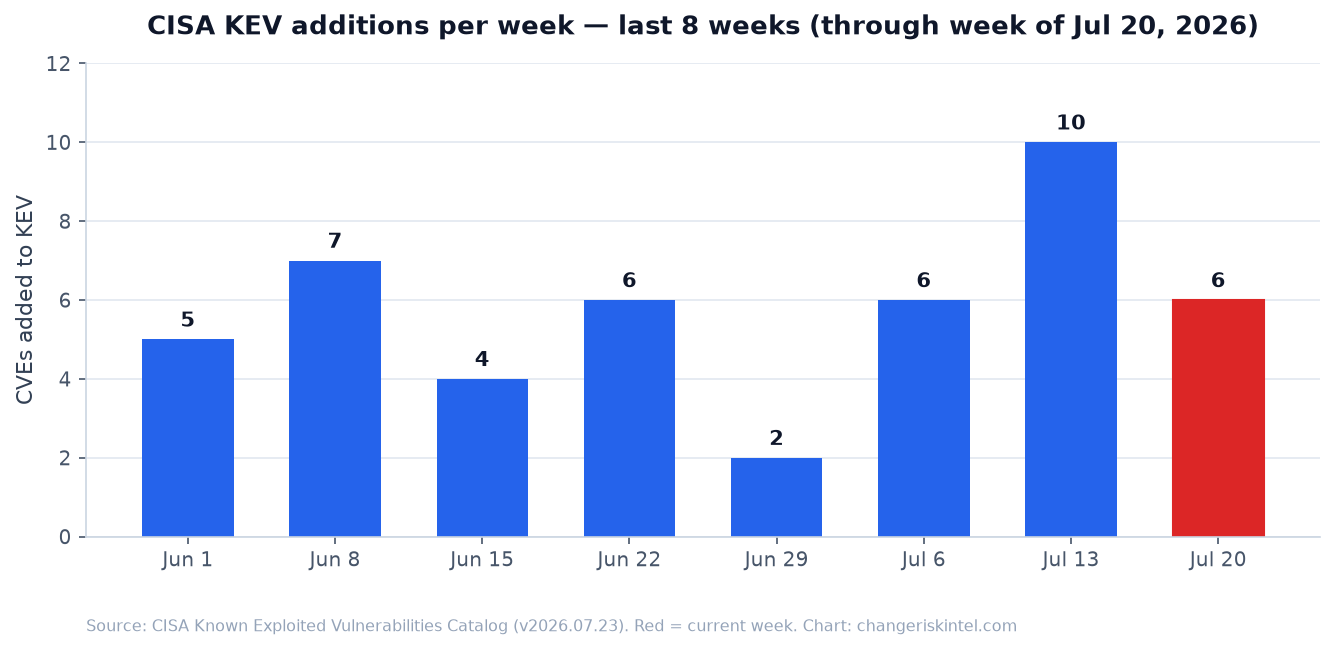
We pulled the CISA KEV catalog directly (version 2026.07.23, 1,653 total entries) and counted additions per week for the last eight weeks. This week’s six additions sit right at the recent baseline, below the July 13 spike of ten, above the quiet week of June 29.
| Week of | KEV additions |
|---|---|
| Jun 1 | 5 |
| Jun 8 | 7 |
| Jun 15 | 4 |
| Jun 22 | 6 |
| Jun 29 | 2 |
| Jul 6 | 6 |
| Jul 13 | 10 |
| Jul 20 | 6 |
The signal for capacity planning: KEV additions run roughly five to seven per week with occasional spikes, so a CAB that can absorb about one emergency security change per weekday is sized correctly for a normal week (CISA KEV catalog).
Get this every Friday
This recap goes out as our weekly newsletter — one email, the week’s change-risk signals, no fluff. Subscribe on the site to get it in your inbox every Friday morning.
Recommended reading:
- Provider-of-Provider Risk: When Your PaaS’s Cloud Fails
- CISA’s July 21 KEV Batch: How a CAB Should Triage 4 CVEs
- 12 External Risk Sources Every CAB Should Monitor
Sources
- CISA — Known Exploited Vulnerabilities Catalog
- CERT-EU — Critical Vulnerability in Microsoft SharePoint (CVE-2026-50522)
- Rapid7 — CVE-2026-16232 Check Point SmartConsole Authentication Bypass
- Internet Status — July 20, 2026 (GitHub Actions, AWS CloudFront)
- Datadog — July 2026 Release Notes
- Hard2bit — NIS2 CJEU Referral: What Changes Without a National Law
Published July 24, 2026.