This Week in Change Risk — Week of Aug 17, 2026
Affiliate disclosure: some vendor links on this site are affiliate links. This recap is general change-management information, not legal, financial, or compliance advice.
Why this week mattered
Every Friday we round up the events that belong on a change advisory board’s radar: what got exploited, what broke, what vendors shipped, and what regulators did, filed under our cybersecurity beat. This week the theme was infrastructure control planes. The federal must-patch list gained eight entries in seven days after two quiet weeks, with three-day deadlines landing on a Friday, and the biggest platform outage came not from a cloud region but from a code-hosting provider’s own load balancers. Here is what a CAB should do with each.
1. KEV additions this week
CISA added eight entries to its Known Exploited Vulnerabilities catalog this week, the most in a single week since July 13, bringing the catalog to 1,673 entries (CISA KEV catalog). The two that justify emergency changes both landed August 18 with a same-week August 21 deadline: CVE-2026-59310, a directory-traversal flaw in the VMware vCenter Syslog server that lets a network attacker execute arbitrary code (CVSS 9.8), and CVE-2026-33824, a double-free in the Windows IKE extension enabling remote code execution (CVSS 9.8), both confirmed against NVD’s records (NVD CVE-2026-59310, NVD CVE-2026-33824). The same day brought a SharePoint authentication-bypass (CVE-2026-55040, CVSS 9.1) and an Apple macOS authentication flaw (CVE-2026-65400, CVSS 9.8). Rounding out the week: Ray-Project Ray code injection (CVE-2025-62593, August 17), an MLflow server-side request forgery (CVE-2026-64849, CVSS 9.3, August 19), and two TrueConf Server flaws (CVE-2026-72529/72530, August 20). For a CAB, vCenter is the emergency of record — it governs the hypervisor estate, so a compromise there is a change to every VM it manages at once.
2. Cloud incidents worth noting
The week’s standout incident was GitHub’s August 17 outage, a 7-hour-47-minute degradation from 13:28 to 21:15 UTC that hit Issues, Pull Requests, APIs, Actions, and Copilot, with web and API error rates near 20 percent at peak (GitHub status incident report). GitHub’s post-mortem traced it to network saturation on load balancers in its Central US datacenter after an Istio sidecar hit its concurrency limit, a misconfigured autoscaling policy that watched the host service but not the sidecar, and “optimistic retry logic” that overloaded internal load balancers (The Register). Recovery dragged on because a latent retry bug in Visual Studio Code amplified Copilot-token traffic roughly tenfold. The weakness a change team should name: the failure was a monitoring blind spot, not a capacity ceiling. Autoscaling that measures the wrong signal is worse than none, because it reports healthy while the real bottleneck saturates. Any change that adds a sidecar or proxy belongs on the cloud-saas register with an explicit note on which metric its scaling watches. Cloudflare logged only minor regional issues this week by comparison.
3. Vendor moves
The vendor calendar was driven by the vCenter KEV. Broadcom updated VMSA-2026-0006 to revision .2 on August 19, the advisory that covers CVE-2026-59310 alongside four other ESX, vCenter, Workstation, and Fusion flaws spanning a 2.7–9.8 CVSS range (Broadcom VMSA-2026-0006). Patches are cumulative, so the fixed version rolls up prior fixes — useful for a change window, but the weakness to name is that Broadcom lists no workaround for the vCenter directory-traversal issue, meaning the only remediation is a version upgrade of a system most organizations treat as too central to touch outside a maintenance window. That tension — a maximum-severity flaw in a change-frozen platform — is exactly the case an emergency-change procedure exists for. Teams running vSphere Foundation or Cloud Foundation should confirm whether their bundled vCenter version is in the affected matrix before scheduling, because the advisory’s response matrix varies by product line and a partial upgrade leaves the Syslog path exposed.
4. Compliance and regulatory
The live regulatory thread stayed European. NIS2 compliance obligations culminate in an October 17, 2026 deadline for essential and important entities across 18 sectors, and the directive’s incident-reporting regime is now the binding one for in-scope organizations (European Commission NIS2 policy). The change-management read is direct: this week’s vCenter and Windows IKE emergencies are precisely the events that start NIS2’s 24-hour early-warning clock for an affected entity, and the emergency changes filed to remediate them become part of the record a regulator can request. A financial-sector CAB should keep DORA in view alongside it — the ICT-resilience regulation is in its supervisory-enforcement phase in 2026, with regulators signaling they will act on incident-reporting gaps. The practical step this week, covered in our compliance beat, is to confirm your emergency-change workflow captures the same timestamps your incident-reporting workflow needs, so the 24-hour and 72-hour narratives reconstruct from one clock rather than two.
5. From the change-management community
The week’s most useful practitioner thread, running across r/sysadmin and r/vmware, reacted to the vCenter KEV with a familiar tension: how do you emergency-patch the one system every change process treats as frozen? The consensus worth borrowing is that “too critical to patch” is a governance failure, not a safety measure. Posters who had rehearsed a vCenter upgrade runbook — snapshot, staged upgrade, rollback plan, HA-mode verification — moved within the three-day window, while those without one were still debating change tickets past the deadline. The takeaway for a CAB: the systems you exempt from routine change are the ones that most need a pre-approved emergency-change template, because they are guaranteed to eventually need an out-of-cycle fix. That pre-work — mapping dependencies and drafting the rollback before the CVE lands — is what our CAB agenda generator is built to surface ahead of an incident, not during one.
6. Chart of the week
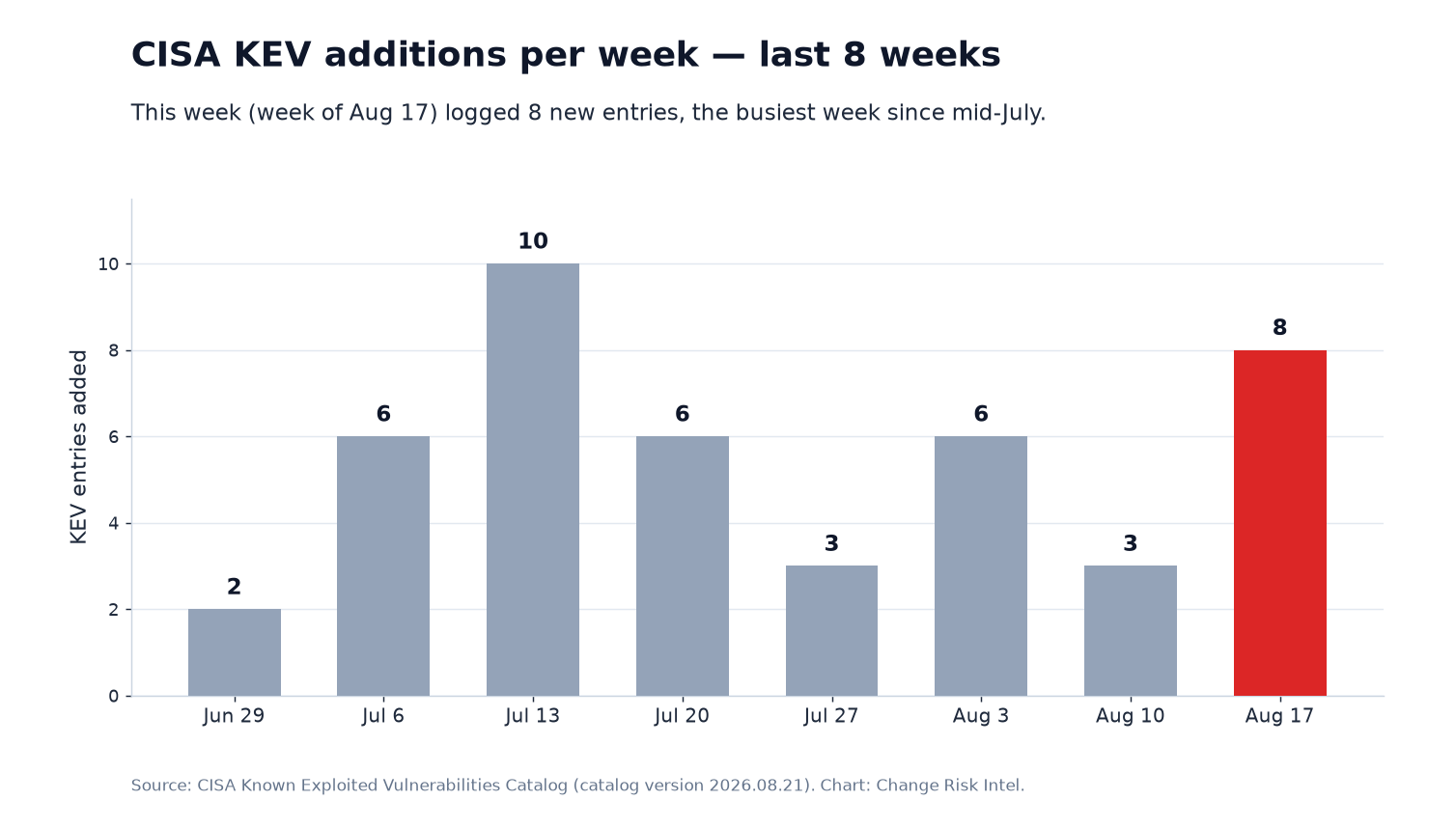
We counted CISA KEV additions per week for the last eight weeks, drawn from the catalog’s own dated entries. This week’s eight additions are the most since the July 13 spike of ten, and a sharp jump from the three-entry weeks that bracketed it.
| Week of | KEV additions |
|---|---|
| Jun 29 | 2 |
| Jul 6 | 6 |
| Jul 13 | 10 |
| Jul 20 | 6 |
| Jul 27 | 3 |
| Aug 3 | 6 |
| Aug 10 | 3 |
| Aug 17 | 8 |
The pattern to watch is not the count but the clustering: six of this week’s eight entries carry critical CVSS scores of 9.1 or higher, so a low-volume week and a high-volume week can demand the same triage effort per entry.
Get this in your inbox
This recap goes out as our weekly newsletter — one email, the week’s change-risk signals, no fluff. Subscribe on the site to get it in your inbox every Friday morning.
Recommended reading from this week:
- Asset Criticality Scoring: ACR vs CMDB vs FIPS 199 — how to decide which systems, like vCenter, get emergency-change priority.
- Risk-Based Patching: How to Defend It to an Auditor — the documentation trail a three-day KEV deadline demands.
- Securing Self-Hosted BI Tools: A Change-Control SOP — the same control-plane exposure problem, for analytics platforms.
Sources
- CISA Known Exploited Vulnerabilities Catalog
- NVD — CVE-2026-59310 (VMware vCenter)
- NVD — CVE-2026-33824 (Windows IKE)
- GitHub Status — August 17 incident report
- The Register — GitHub blames 8-hour outage on autoscaling fail and VS Code retry storm
- Broadcom — VMSA-2026-0006 (VMware ESX, vCenter, Workstation, Fusion)
- European Commission — NIS2 Directive policy
Published August 21, 2026.