Azure Outage History: A Timeline of Change-Triggered Failures
This article is operational analysis for change and resilience planning, not vendor criticism or legal advice. No affiliate links appear in this post.
When a hyperscaler goes down, the first assumption is often a cyberattack or a datacenter fire. The record says otherwise. Look at the major Azure incidents of the last several years and a pattern emerges: the trigger is almost always a change. A configuration push, a code deployment, an automated key rotation, or a maintenance operation propagates further than intended, and a control that should have caught it does not.
That is a change-management story, not just a reliability one. The same disciplines a change advisory board applies internally, staged rollout, blast-radius limits, tested rollback, are exactly what fails in these incidents. This timeline walks the significant Azure outages from 2018 to 2026, names the triggering change for each, and pulls out the lessons a change or resilience owner can apply to their own environment. For the same treatment of the other big cloud, see our AWS us-east-1 outage timeline.
Why this matters
If outages were random acts of hardware, you could not do much beyond buying redundancy. Because they are overwhelmingly change-triggered, they are partly preventable and largely survivable with the right process. Understanding how a vendor’s own change controls failed tells you where your dependency on that vendor is most fragile, and where your own failover testing has to be real rather than assumed. It also reframes the conversation with leadership: the risk is not that Azure is unreliable, it is that a single upstream change can cross into your environment faster than your team can react, and the mitigation is architectural and procedural rather than a support ticket.
The timeline of major Azure outages
The chart below plots the significant incidents by date and colors each by the type of change that set it off. Bubble size approximates the impact duration.
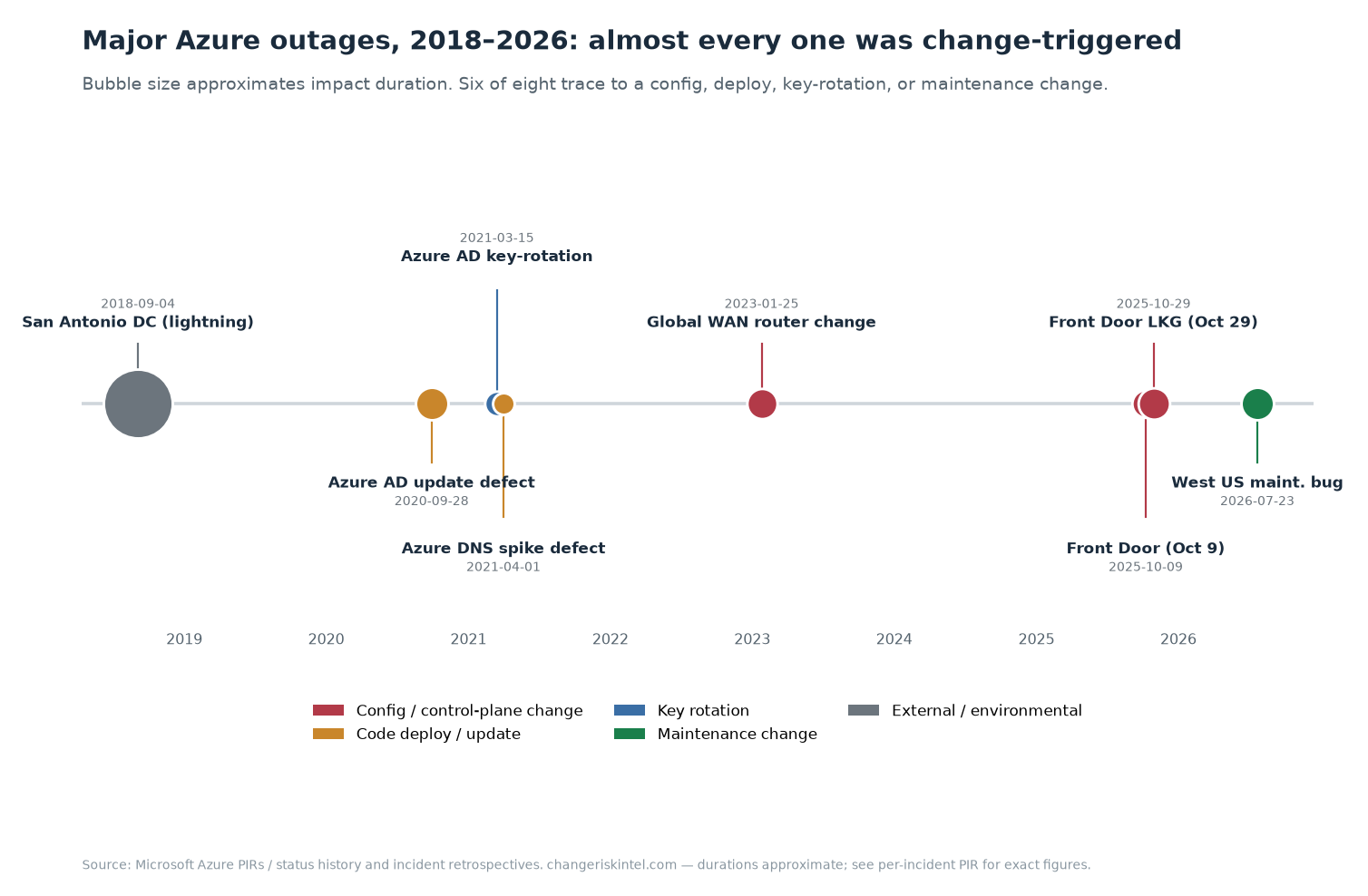
September 4, 2018 — San Antonio datacenter. The rare outlier that was not a change. A severe thunderstorm and a lightning-adjacent voltage swell damaged cooling systems at a South Central US datacenter, forcing hardware to shut down to protect data, per Medha Cloud’s Azure outage history. Recovery ran into days for some storage-dependent services because hardware had to be inspected before data came back online. The lesson is old but permanent: single-region dependency is a resilience choice you make in advance.
September 28, 2020 — Azure AD update defect. A service update to Azure Active Directory introduced a code defect, and rollback was delayed by a latent flaw in the safe-deployment tooling itself, according to the same history. Sign-ins failed for roughly five hours across Microsoft 365, Teams, and the Azure portal. When your rollback path shares a defect with the thing it is supposed to roll back, you have no rollback.
March 15, 2021 — Azure AD key rotation. An automated cryptographic key-rotation process moved a signing key out of an operation that still depended on it, leaving Azure AD unable to validate a class of tokens it had already issued. Per AzureDown’s incident writeup, sign-in failures began around 19:00 UTC worldwide and mitigation completed around midnight UTC. Users holding valid cached tokens kept working; everyone needing a fresh token was locked out. A routine, automated change to a live cryptographic dependency took down global authentication.
April 1, 2021 — Azure DNS spike defect. An anomalous surge in DNS queries exposed a code defect in the service’s own volumetric-spike defenses, and the mitigation logic amplified the problem it was meant to absorb, per Medha Cloud. Name resolution degraded for about an hour. A protective control that misfires under load is its own failure mode.
January 25, 2023 — global WAN router change. A command issued while adding a router to Microsoft’s global wide-area network propagated changes across the WAN, breaking connectivity between regions and to the internet, according to Medha Cloud’s account. Networking, Microsoft 365, Teams, Outlook, and the portal were hit for roughly two to five hours depending on service and region. A single WAN change with global blast radius is the textbook case for staged, region-by-region rollout that this incident did not get.
October 9 and 29, 2025 — Azure Front Door. Two related incidents. In the first, a customer configuration change triggered a control-plane defect that created incompatible tenant metadata, and a manual cleanup of stuck metadata bypassed the configuration protection layer that had initially blocked propagation, per Microsoft’s own lessons-learned post. Availability impact concentrated in Europe (about 6%) and Africa (about 16%). Three weeks later, a different sequence of configuration changes across two control-plane versions produced incompatible metadata again. Because the data-plane failure was asynchronous, every health check passed during rollout, the bad metadata propagated globally, and it poisoned the last-known-good snapshot. Recovery of the master process took about 4.5 hours because it had to reload hundreds of thousands of configurations from scratch. The Front Door pair is the sharpest case study on this list: the safety net itself, the last-known-good snapshot, was corrupted by the change.
July 23, 2026 — West US maintenance bug. A routine device-maintenance activity required isolating specific network paths, but a bug in Azure’s maintenance-request conversion system incorrectly marked additional devices as part of the event and removed IP routes from more devices than intended, per IncidentHub’s analysis. Traffic in and out of the entire West US region was disrupted from 14:44 to 19:41 UTC, just under five hours. We covered the change-board takeaways in detail in our West US maintenance-outage CAB lessons. The trigger was tooling that scoped a change wider than the human who approved it intended.
The pattern: change controls that failed
Line the incidents up and the failure modes rhyme. In 2020 the rollback tooling shared the defect. In 2021 an automated key change hit a live dependency. In 2023 a WAN command had no staged rollout. In 2025 the last-known-good snapshot was poisoned and asynchronous validation passed a broken change. In 2026 the maintenance tooling widened the blast radius on its own. Each is a control a mature change process is supposed to provide: tested rollback, dependency checks, staged rollout, a trustworthy known-good state, and accurate blast-radius scoping.
The vendor’s process is not your problem to fix. But knowing which control tends to fail tells you where to harden your side of the boundary. If a Front Door config push can take down connectivity for every application onboarded to it, your resilience plan cannot assume the front door is always open.
The asynchronous-validation trap
The October 29, 2025 Front Door incident deserves a second look because it breaks an assumption most change processes rely on. Per Microsoft’s lessons-learned post, the data-plane failure mode was asynchronous, which meant every health-check validation embedded in the protection systems passed during rollout. The change looked healthy at each gate and was still catastrophic.
That is the uncomfortable part. A staged rollout with health gates is the standard answer to blast radius, and here it did not help, because the defect surfaced only after asynchronous cleanup ran, downstream of every check. The corrupted state then updated the last-known-good snapshot, so the usual escape hatch, roll back to the last good config, pointed at a poisoned target. For your own changes, the takeaway is that green health checks during a rollout are necessary but not sufficient, and a known-good state you cannot independently verify is not a safety net you can trust.
What to do about it
- Treat single-region and single-front-door dependency as a documented risk, not a default, and record the blast radius you accept when you onboard to a shared control plane.
- Test cross-region failover for real on a schedule, because an untested failover is an assumption, not a control. See our guide to cross-region failover testing.
- Do not let your own rollback path share infrastructure or code with the change it protects, the 2020 lesson that keeps recurring.
- Watch provider status the same way you watch your own, and wire the cloud status heatmap or an equivalent into your incident tooling so a provider event opens a ticket automatically.
- Read the post-incident reviews for the providers you depend on and map each named control failure to whether your side has the same gap.
- Fold provider-dependency risk into your change board’s standing agenda so a hyperscaler incident triggers a review, not a scramble, alongside your other cloud and SaaS resilience work.
Frequently asked questions
What causes most major Azure outages? A change: a config push, a code deploy, an automated key rotation, or a maintenance operation that spread wider than intended.
What was the October 2025 Azure Front Door outage? Two related incidents; on October 29 a config-change sequence produced incompatible metadata that propagated globally and poisoned the last-known-good snapshot, with about 4.5 hours to recover the master process.
Was the March 2021 Azure AD outage a cyberattack? No. An automated key rotation removed a signing key still in use, invalidating tokens worldwide until reverted.
How can I protect my systems from Azure outages? Document single-region and shared-control-plane dependency, test failover regularly, keep rollback independent, and monitor provider status in your tooling.
Where does Microsoft publish Azure post-incident reviews? On the Azure status history page, for broad-impact events on or after November 20, 2019.
For more on surviving provider failures, see our cloud and SaaS resilience coverage.
Sources
- Microsoft: Azure Front Door lessons learned following October 2025 outages
- Microsoft: Azure Status Overview and Post-Incident Reviews
- Microsoft Azure Status History
- AzureDown: Azure AD Outage, March 15, 2021
- Medha Cloud: Azure Outage History, Every Major Incident 2020–2026
- IncidentHub: Azure West US Outage, July 23, 2026
Published September 16, 2026.