Cross-Region Failover Testing: Why Untested DR Fails
Why this matters
When a cloud region degrades, the painful discovery is rarely that a team had no disaster-recovery plan. It is that the plan existed on paper, the secondary region was provisioned and paid for every month, and nobody had ever run the actual switchover under load. The Azure West US maintenance-automation outage in late July 2026, which we covered in our change-safety breakdown of that incident, was a reminder that redundancy inside a region does not save you when the impairment is the region, or a control plane spanning it.
That gap is a change-management problem as much as an architecture one. A failover is one of the highest-blast-radius changes an organization can execute, it is performed under stress, and it usually runs on a runbook that has never been rehearsed end to end. This piece lays out what cross-region failover actually requires, why untested plans quietly fail, and how to put a testing cadence under change control so the switch works the one time it counts.
In-region redundancy is not regional resilience
The first confusion to clear up is the difference between availability zones and regions. Availability zones are physically separate data centers within one region, with independent power and cooling, connected by low-latency links. They protect a workload against the loss of a single data center. Microsoft’s own guidance is explicit that many Azure regions are not paired and instead rely on availability zones as their primary redundancy, while a smaller set of services use region pairs for geo-replication and staged recovery.
The limit is straightforward: a multi-AZ design does nothing for you when the failure crosses the whole region. AWS frames this directly in its Well-Architected guidance, noting that for location impairments such as an Availability Zone or an entire Region, you need systems in place to fail over to healthy resources in unimpaired locations. If your definition of a disaster extends beyond the loss of one data center to the loss of a region, AWS’s disaster-recovery whitepaper is equally blunt that backup-and-restore, pilot light, warm standby, or multi-site active/active are the approaches that actually address it. None of those is automatic. Each is a plan you have to invoke, and invoking it is a change.
The four DR strategies set your recovery objectives
Before you can test a failover, you have to decide what “recovered” means. That is what recovery time objective (RTO) and recovery point objective (RPO) capture: RTO is how long the workload can be down, RPO is how much data you can afford to lose. AWS’s four DR strategies map cost and complexity against these two numbers.
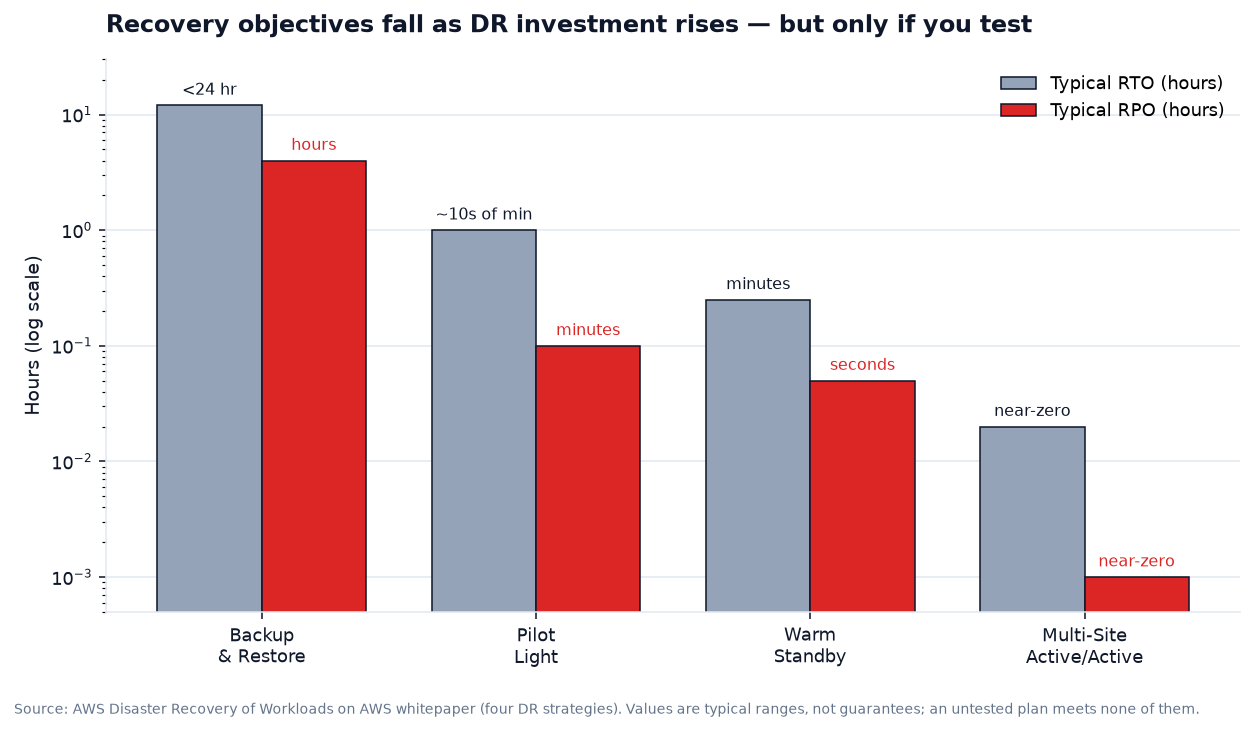
Per the AWS disaster-recovery whitepaper and its Well-Architected recovery guidance, the tiers are:
- Backup and restore — RPO in hours, RTO in 24 hours or less. You replicate data to a recovery region and redeploy infrastructure and code there when disaster strikes. Continuous backups with point-in-time recovery can pull RPO as low as five minutes.
- Pilot light — a minimal copy of core services (often just the data layer) runs in the recovery region; you scale it up on failover. Lower RTO than backup-and-restore, at higher standing cost.
- Warm standby — a scaled-down but always-running copy of the full workload in the recovery region, ready to take traffic quickly.
- Multi-site active/active — the workload serves traffic from multiple regions simultaneously, giving RPO near zero and RTO potentially zero. AWS names the catch directly. You must synchronize data across regions, and writes to the same record in two regional replicas can conflict in ways you have to design around.
One warning AWS repeats is worth pulling out for change managers: replication alone does not protect you against data corruption or destruction. If a bad write or a ransomware event corrupts the primary, active/active replication faithfully copies the damage to the secondary. That is why the whitepaper pairs multi-region strategies with point-in-time recovery, and why “we replicate everything” is not the same as “we can recover.”
Why the untested plan is the one that fails
Here is the mechanism that turns a funded DR plan into an outage. A cross-region failover is not a single button. AWS’s backup-and-restore architecture guidance breaks the recovery into three steps you must execute in order under pressure: detect the impact, restore infrastructure and data, then fail over and re-route requests. Even a well-instrumented multi-region setup with a cross-region read replica still requires you to promote the replica to primary and then re-point traffic to the new endpoint, as the Well-Architected failover guidance states. Each of those steps has dependencies (DNS, IAM in the recovery account, infrastructure-as-code templates, health checks), and any one of them silently rotting since the last deploy will stall the whole sequence.
The failures that surface only during a real event are predictable: an infrastructure-as-code template that no longer provisions cleanly in the second region, a security group or quota that was never mirrored, a DNS TTL too long to re-point traffic quickly, a runbook that names an engineer who left, or a secondary database whose replication lag blew past the RPO months ago without anyone watching. None of these show up on an architecture diagram. All of them show up during a test.
This is exactly the argument for resilience testing as a pipeline step. AWS’s prescriptive guidance describes resilience testing as deterministic validation of known mechanisms — circuit breakers, retries, failovers — run continuously so you do not introduce regressions to your resilience posture. The discipline traces back to Netflix’s Chaos Monkey, which randomly terminated production instances to force engineers to build services that tolerate failure. The principle a CAB should internalize: a failover mechanism is a theory until a controlled test makes it produce a pass or fail result.
Put failover testing under change control
A failover test is itself a high-risk change, so it belongs in your change process, not in an engineer’s spare afternoon. The goal is to make the test boring and repeatable, which is the same thing as making the real failover survivable.
- Write the RTO and RPO into the service definition first. You cannot pass or fail a test without a target. Pin each workload to one of the four DR tiers and record the committed RTO and RPO, using AWS’s DR objectives guidance as the reference. Score the change with our change risk score tool so the failover test carries the risk rating it deserves.
- Schedule a recurring game day as a standard change. Put a cross-region failover exercise on the calendar — quarterly is a common floor for critical workloads — and run it through the CAB like any other change, with a defined window, rollback, and comms. Use our CAB agenda generator to structure the review so the test leaves an audit trail.
- Test the failback, not just the failover. AWS ships a whole cross-region failover and graceful failback solution precisely because returning to the primary region is its own risky change. A team that can fail over but cannot fail back cleanly is stuck running on the recovery region until someone improvises.
- Deploy the recovery region from the same infrastructure-as-code. AWS’s guidance is to use CloudFormation or CDK to create infrastructure consistently across regions. If the second region drifts from the first, your test result does not transfer to the real event. Consider a separate recovery account so a mistake in the primary cannot cascade.
- Measure the test against the objective and record the gap. Capture the actual recovery time and data-loss window, compare against the committed RTO and RPO, and file any miss as a change action item. Feed recurring dependency failures into your vendor risk view — our fourth-party dependency guidance covers how upstream provider failures cascade into your recovery path.
Where tooling helps, and where it does not
Cloud providers give you real machinery for this. AWS names Route 53, Application Recovery Controller, CloudFront, and Global Accelerator as the services that route traffic across regions during failover, and Aurora global databases replicate data to a secondary region for fast promotion. Each has a limit a CAB should hear plainly. Route 53 health checks re-point traffic, but they cannot promote a database or fix a broken IaC template — the orchestration between steps is still yours to own. Application Recovery Controller automates the routing decision, but it depends on the readiness checks you configured being both present and honest, and a check that was never wired to a real dependency will report green into a failed failover. And a global database gives you near-zero RPO for infrastructure loss while offering no protection against a corrupt write that replicates in milliseconds. The tooling shortens the failover; it does not decide when to pull the trigger or guarantee the plan behind it was ever tested. That judgment stays with the change process. For the broader picture on cloud reliability under change, see our cloud & SaaS pillar.
What to do about it
- Classify every critical workload into a DR tier and write down its committed RTO and RPO.
- Confirm your redundancy story matches your risk: availability zones cover a data-center fault; only a cross-region strategy covers a regional impairment.
- Schedule a recurring cross-region failover game day as a standard, CAB-reviewed change.
- Test failback as deliberately as failover, and deploy the recovery region from the same infrastructure-as-code.
- Record every test result against the objective and treat misses as tracked change actions.
Frequently asked questions
Sources
- AWS, Disaster recovery options in the cloud (four DR strategies)
- AWS Well-Architected, Plan for disaster recovery
- AWS Well-Architected, Fail over to healthy resources
- AWS Well-Architected, Disaster recovery objectives (RTO/RPO)
- AWS, Backup and restore with rapid recovery
- AWS, Cross-region failover and graceful failback solution
- AWS Prescriptive Guidance, Chaos engineering and resilience testing
- Microsoft Learn, Azure region pairs and nonpaired regions
- Microsoft Learn, Availability zones overview
Published August 4, 2026.