The Patch You Could Calendar: SharePoint's RCE Chain
This article is operational change-management guidance for CAB and infrastructure teams, not incident-response or legal advice. Validate every patch step against the vendor advisory for your farm. No affiliate links appear below.
Table of contents
- The rare patch you get to plan
- What the SharePoint chain actually is
- The two-cycle timeline change teams could see coming
- Staging a planned emergency change
- What to do about it
- FAQ
- Sources
The rare patch you get to plan
Most of the emergency changes a change advisory board runs are reactive. A vulnerability lands in the CISA Known Exploited Vulnerabilities catalog, a three-day clock starts, and the board improvises. We wrote about exactly that pressure in our LoadMaster KEV three-day-clock runbook, where the patch was available for months but the enforced window was 72 hours.
The SharePoint RCE chain that Microsoft closed in its August 2026 update cycle is the opposite kind of event, and a more instructive one. The full attack chain was known to Microsoft in May. The fix was deliberately split across two Patch Tuesdays, and that plan was published in Rapid7’s July 14 advisory (Rapid7 CVE-2026-55040 disclosure). Every defender running on-premises SharePoint had roughly four weeks of notice that a critical remote code execution patch was arriving on a specific date.
That changes the change-management question entirely. The problem is not “how do we move in 72 hours.” It is “we have a firm date for a high-blast-radius patch on a crown-jewel system, so why would we treat release day as a surprise?” A board that plans the change during the notice window turns a scramble into a scheduled deployment. A board that ignores the notice inherits the scramble anyway, just with less excuse.
What the SharePoint chain actually is
Rapid7 Labs, through a research project led by Senior Principal Security Researcher Stephen Fewer, found two vulnerabilities in on-premises Microsoft SharePoint Server that chain together to give unauthenticated remote code execution (Rapid7 CVE-2026-55040 disclosure). The chain was built as an entry for the Pwn2Own Berlin competition.
The first half is CVE-2026-55040, an authentication bypass caused by “several issues in the JWT token validation pipeline,” carrying a CVSS 3.1 score of 9.1 and mapped to CWE-1390, Weak Authentication (Rapid7 CVE-2026-55040 disclosure, Microsoft MSRC advisory for CVE-2026-55040). It lets a remote, unauthenticated attacker impersonate a chosen SharePoint user or administrator, provided the attacker already knows that user’s Active Directory Security ID or User Principal Name (Zetik summary of the Rapid7 disclosure). On its own, it is an identity-spoofing bug; chained to the second flaw, it becomes full code execution.
The second half is the remote code execution component. Microsoft withheld that fix until the August 2026 cycle, so running only July’s update left the chain incomplete but not closed. As one August advisory put it plainly, “If you ran July’s update and assumed you were done, you are not” (Byteiota August SharePoint brief).
There is a critical nuance the July advisory called out and every CAB should internalize: “Patching CVE-2026-55040 will successfully break this exploit chain” (Rapid7 CVE-2026-55040 disclosure). Applying the July authentication-bypass fix removed the unauthenticated path even before the August RCE patch existed. The two-cycle split, in other words, was survivable precisely because breaking one link breaks the whole chain.
This chain sits inside a wider SharePoint problem the board should track. A separate matched pair of deserialization RCE bugs, CVE-2026-50522 and CVE-2026-58644, both scored 9.8 and both triggerable without authentication, were patched in July, and CVE-2026-50522 was demonstrated at Pwn2Own Berlin before landing in the KEV catalog (Censys advisory on CVE-2026-50522 and CVE-2026-58644). Security researchers observed active exploitation of CVE-2026-50522 within hours of public proof-of-concept code, with attackers stealing SharePoint machine keys to keep access after patching (Security Affairs on CVE-2026-50522 exploitation). On-premises SharePoint has been a repeat emergency-change target all summer, which is why a planned patch on that platform deserves a rehearsed process.
The two-cycle timeline change teams could see coming
The value of this case study is the calendar. Here is the disclosure sequence, drawn from Rapid7’s own published timeline (Rapid7 CVE-2026-55040 disclosure):
- May 18, 2026: Rapid7 disclosed the full unauthenticated RCE chain to Microsoft, which acknowledged receipt the same day.
- May 20, 2026: Microsoft confirmed the findings and stated the chain would be fixed across two cycles, the authentication bypass in July and the RCE in August.
- July 14, 2026: Rapid7 and Microsoft publicly disclosed CVE-2026-55040 and the two-cycle plan.
- August 2026 cycle: the RCE half shipped, completing the fix.
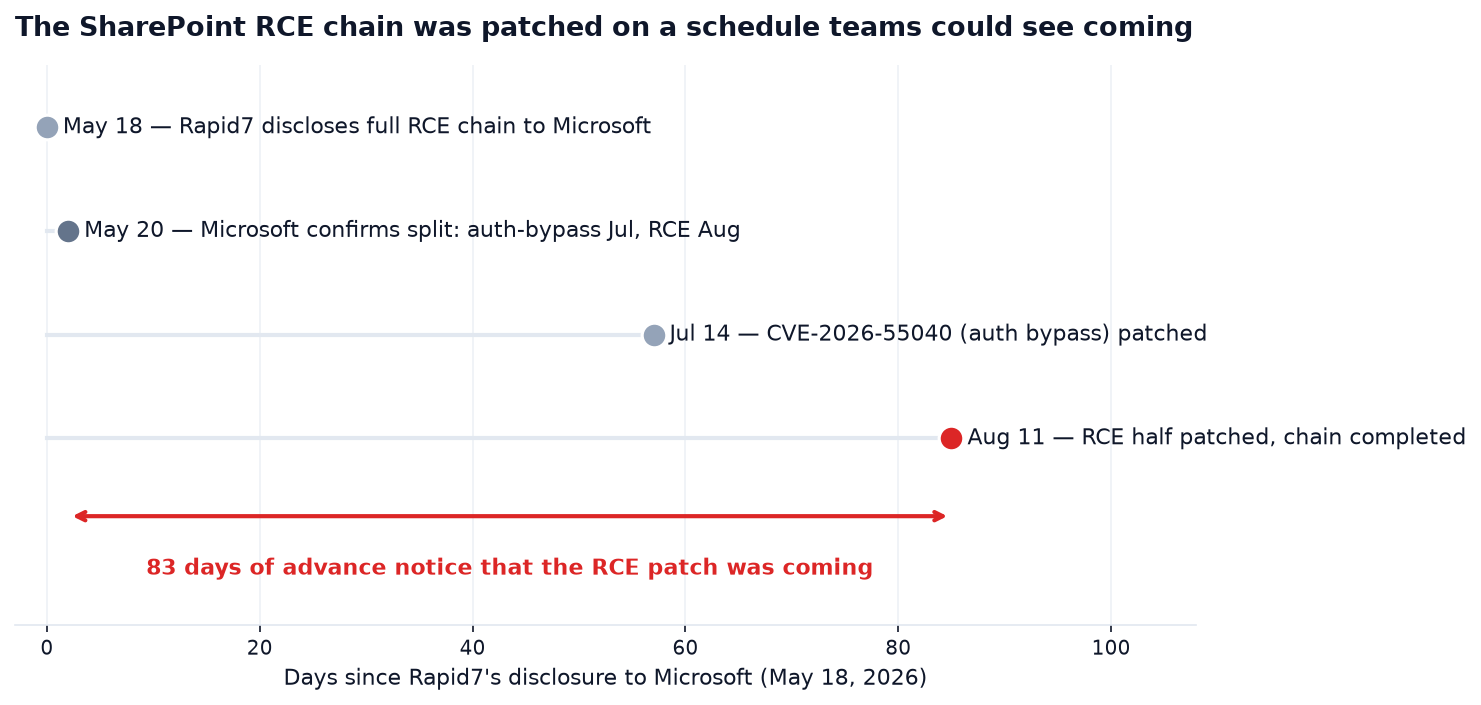
Read from the vendor’s side, there were 83 days between Microsoft’s internal confirmation and the August fix. Read from the defender’s side, the public notice window opened on July 14, giving roughly four weeks before the RCE patch. Either way, this was not a zero-day dropped without warning. The date was on the calendar, and the mitigating action, applying July’s update to break the chain, was available the whole time.
Compare that with how most patch decisions get made. The August Patch Tuesday forecast noted that only a small fraction of disclosed vulnerabilities are ever confirmed exploited, and warned against treating every CVE as an emergency (Help Net Security August 2026 forecast). The signal that separates this SharePoint chain from routine patching is not the CVSS number. It is the combination of a crown-jewel system, a public exploit pedigree from Pwn2Own, and a known date. Those three together are what should have promoted it to a planned emergency change.
Staging a planned emergency change
A planned emergency change is the professional middle ground between a routine change, which is too slow for a known-exploited class of bug, and a reactive emergency, which is too chaotic for something you saw coming. The board pre-approves the change during the notice window, then executes on release day against a rehearsed plan. Here is how to run it for a case like this SharePoint chain.
Pre-stage during the notice window. As soon as a split-cycle or embargoed patch is announced, open the change ticket with a target date matching the vendor’s cycle. Score it now, not on release day, using our change risk score tool, so the emergency ticket carries a defensible rating before anyone is under pressure.
Break the chain early where you can. The single most important lesson here is that July’s authentication-bypass fix broke the whole chain. If a vendor tells you patching one component neutralizes the unauthenticated path, apply that component immediately and treat the later patch as completing the fix, not as the only defense.
Confirm your build inventory in advance. For this chain, remediation depends on exact SharePoint builds and knowledge-base updates: KB5002882 for Subscription Edition, KB5002883 for Server 2019, and KB5002891 for Enterprise Server 2016 (Rapid7 CVE-2026-55040 disclosure). Verifying which build each farm server runs is a task you do during the quiet window, not while the maintenance clock ticks.
Rehearse the sequence, including post-deploy steps. SharePoint patches are farm-wide and order-sensitive. The published guidance calls for installing the July updates first if not already applied, then the August updates across every server in the farm, then running the PSConfig configuration step on each server (Byteiota August SharePoint brief). A change that skips PSConfig is a change that looks done but is not. Bake those steps into the plan and the rollback into the ticket before release day.
Run the CAB as a go or no-go, not a debate. By release day the analysis is finished. Use a scoped CAB agenda to confirm the pre-checks passed, the window is open, and the rollback is staged. The meeting should take minutes because the work happened during the notice window. The rest of the emergency-change playbooks live on our change-management pillar.
What to do about it
- Inventory every on-premises SharePoint farm now, including hybrid deployments, disaster-recovery copies, and partner-facing instances. Record the exact build on each server.
- Confirm July’s CVE-2026-55040 fix is applied everywhere. That authentication-bypass patch breaks the unauthenticated chain and is the highest-value single action.
- Apply the August 2026 update across every farm server, following the documented order, then run PSConfig on each server to finish the deployment.
- Treat announced split-cycle and embargoed patches as planned emergency changes. Open the ticket on announcement day with the vendor’s cycle as the target date.
- Watch the related SharePoint KEV entries, including CVE-2026-50522, which is actively exploited, and rotate machine keys on any server that may have been reached before patching.
- Feed the lesson back into your CAB policy. Add a standing rule that a known date plus a crown-jewel system plus a public exploit pedigree promotes a patch to the planned-emergency track. Track live KEV context with our CISA KEV live tool.
FAQ
What is CVE-2026-55040? CVE-2026-55040 is a critical authentication bypass in on-premises Microsoft SharePoint Server, scored CVSS 9.1, caused by issues in the JWT token validation pipeline. It lets an unauthenticated attacker impersonate a chosen SharePoint user or administrator and is the first half of a Rapid7-disclosed unauthenticated RCE chain (Rapid7 CVE-2026-55040 disclosure).
Why did Microsoft split the SharePoint RCE fix across two Patch Tuesdays? Microsoft confirmed to Rapid7 on May 20, 2026 that it would fix the chain across two cycles, the authentication bypass in July and the RCE component in the August 2026 update, and the plan was public from July 14 (Rapid7 CVE-2026-55040 disclosure).
Does applying July’s update protect me before the August patch? Largely yes for this chain. Rapid7 stated that patching CVE-2026-55040 breaks the exploit chain, removing the unauthenticated path. Apply the August RCE patch to fully remediate, but the July fix is the highest-value early action (Rapid7 CVE-2026-55040 disclosure).
Which SharePoint versions and KB updates are affected? Remediation for CVE-2026-55040 uses KB5002882 for Subscription Edition, KB5002883 for Server 2019, and KB5002891 for Enterprise Server 2016. Confirm each farm server’s exact build before deploying (Rapid7 CVE-2026-55040 disclosure).
What is a planned emergency change? A planned emergency change carries emergency-level urgency but has a known future date, such as a split-cycle or embargoed vendor fix. The CAB pre-approves and stages it during the notice window, then executes on release day against a rehearsed plan instead of improvising.
Do I need to run PSConfig after patching SharePoint? Yes. Published guidance calls for installing the July updates first if needed, then the August updates across every farm server, then running PSConfig on each server. Skipping PSConfig leaves the deployment incomplete (Byteiota August SharePoint brief).
Sources
- Rapid7 — CVE-2026-55040: Microsoft SharePoint JWT Token Authentication Bypass (Fixed)
- Microsoft MSRC — Security update guide advisory for CVE-2026-55040
- Security Affairs — CVE-2026-50522 under active exploitation after PoC
- Zetik — Rapid7 and Microsoft disclose SharePoint CVE-2026-55040
- SecurityWeek — Microsoft patches record 622 vulnerabilities, including two exploited zero-days
- Help Net Security — August 2026 Patch Tuesday forecast
- Byteiota — Microsoft August Patch Tuesday 2026: Patch SharePoint Now
- Censys — Advisory on CVE-2026-50522 and CVE-2026-58644
Published August 11, 2026.