This Week in Change Risk — Week of Aug 24, 2026
Affiliate disclosure: some vendor links on this site are affiliate links. This recap is general change-management information, not legal, financial, or compliance advice.
Why this week mattered
Every Friday we round up the events that belong on a change advisory board’s radar: what got exploited, what broke, what vendors shipped, and what regulators did, filed under our cybersecurity beat. This week the theme was speed. CISA set its fastest-ever remediation clock on a maximum-severity Oracle flaw, then followed with a mixed batch that included CVEs a decade old, proof that “old” does not mean “safe.” The vendor side leaned into AI-assisted incident response. Here is what a CAB should do with each.
1. KEV additions this week
The headline entry was CVE-2026-21962, an improper-access-control flaw (CVSS 10.0) in Oracle HTTP Server and the Oracle WebLogic Server Proxy Plug-in, added to the KEV catalog on August 24 with a three-day federal deadline — the tightest CISA is authorized to set under BOD 26-04 (The Register). Oracle patched it in its January 20, 2026 Critical Patch Update, so the exposure this week is entirely unpatched estates (Oracle CPU January 2026). Then on August 26, CISA added six more, spanning a Citrix NetScaler ADC/Gateway memory-overflow (CVE-2026-8452, CVSS 9.8), a Microsoft SQL Server flaw (CVE-2019-1068, CVSS 8.8), a Linux kernel privilege-escalation (CVE-2022-0995), an Ajax.NET Professional defect (CVE-2021-23758), and two Red Hat component issues in libuser and ABRT (CVE-2015-3246, CVE-2015-5287) (Security Online). For a CAB, the Oracle flaw is the emergency of record; the August 26 batch is a reminder that KEV additions are not always fresh CVEs, so exception registers built only around “current-year” patches miss half the exposure.
2. Cloud incidents worth noting
The dominant platform story remained GitHub’s reliability crisis. After the August 17 outage — a 7-hour-47-minute disruption that hit Actions, pull requests, issues, Copilot, and APIs — GitHub used this week to reiterate its “we let you down” commitment and lay out the fix (The Register). CTO Vladimir Fedorov was explicit that “neither outage was caused by a code or configuration change” — the failure modes were latent in the platform, exposed by retry storms and misconfigured limits rather than a fresh deploy. That is the detail a change team should sit with: a change-freeze would not have prevented these outages, because the trigger was traffic growth against unaddressed architectural debt. GitHub’s next milestone is an architecture that scales read capacity linearly with readers, rolled out gradually starting with the largest monorepos. The weakness to name is candor’s flip side — a vendor telling you the fix is a months-long, staged re-architecture means the risk is not resolved, and any cloud-saas dependency register should treat GitHub availability as an open item, not a closed one.
3. Vendor moves
PagerDuty shipped its August product drop, and it is AI-operations-heavy. The SRE Agent now attaches to Escalation Policies (Early Access), joining incidents as a virtual responder that shares triage data and next steps, while Recommended Workflows (GA) ranks and explains the best runbook against live incident context, and Agent Connectors and Tools (GA) pull logs, metrics, and knowledge-base context over MCP or API (PagerDuty Product Drops, August 2026). PagerDuty also added Advance team-level permissions (GA) to enforce compliance boundaries on AI adoption. The change-management read: an agent that auto-recommends and can help execute a workflow is, functionally, an actor proposing changes during an incident. The weakness a CAB should flag before enabling it is auditability — an AI responder’s “next steps” need the same change-record trail as a human’s, or your post-incident review inherits a decision no one can attribute. The team-level permission control is the guardrail; treat turning the agent on as its own reviewed change.
4. Compliance and regulatory
Two threads stayed live. In the US, the SEC cybersecurity disclosure rules — adopted July 26, 2023, with Form 8-K Item 1.05 requiring material-incident disclosure within four business days of a materiality determination — remain in effect and enforceable as of this week, despite 2025–2026 petitions from banking and securities trade groups to rescind Item 1.05 (Top Floor Security regulatory radar). In the EU, NIS2 obligations culminate in an October 17, 2026 deadline for essential and important entities, and member-state inspections are underway (European Commission NIS2 policy). The change-management link is the same on both sides of the Atlantic: this week’s Oracle emergency change is exactly the event that could start a materiality assessment or a NIS2 early-warning clock. The practical step, covered in our compliance beat, is to confirm your emergency-change workflow stamps the same timestamps your disclosure workflow needs, so the four-business-day and 24-hour narratives reconstruct from one clock, not two reconciled after the fact.
5. From the change-management community
The week’s most useful practitioner thread, running across r/sysadmin and r/cybersecurity, wrestled with CISA’s three-day Oracle clock: how do you honor a 72-hour deadline on middleware that patched in January, when the real blocker is finding which hosts still run the vulnerable plug-in? The consensus worth borrowing is that the deadline is a discovery problem, not a patching problem — teams that maintained an accurate inventory of internet-facing Oracle HTTP Server and WebLogic Proxy instances closed the window in an afternoon, while those relying on tribal knowledge spent the three days searching. The takeaway for a CAB: a compressed remediation deadline exposes inventory debt instantly, because you cannot emergency-change an asset you cannot list. Pre-wiring that inventory-to-emergency-change handoff — before the CVE lands — is what our CAB agenda generator is built to surface ahead of an incident, not during one.
6. Chart of the week
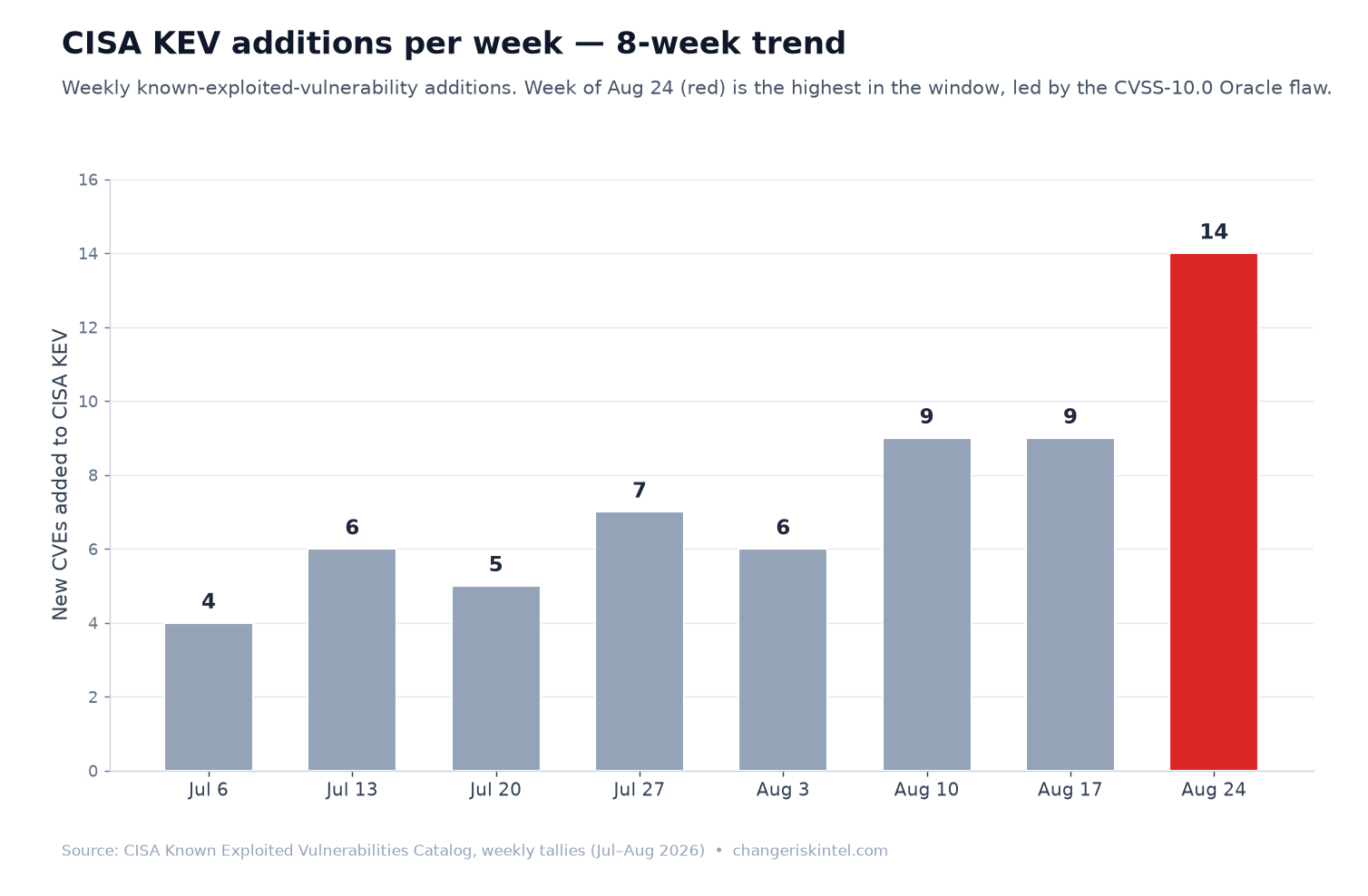
We counted CISA KEV additions per week for the last eight weeks, drawn from the catalog’s dated entries. The week of August 24 is the busiest in the window at 14, driven by the Oracle perfect-10 on Monday and the six-CVE batch on Wednesday, and a clear step up from the six- to nine-entry weeks that preceded it.
| Week of | KEV additions |
|---|---|
| Jul 6 | 4 |
| Jul 13 | 6 |
| Jul 20 | 5 |
| Jul 27 | 7 |
| Aug 3 | 6 |
| Aug 10 | 9 |
| Aug 17 | 9 |
| Aug 24 | 14 |
The trend line is the point: KEV additions have roughly doubled over eight weeks, so a change process that treats federal must-patch entries as an occasional interruption is now behind the cadence. Weekly is the new normal.
Get this in your inbox
We publish this recap every Friday and a deep-dive every Monday and Wednesday. If you would rather not check the site, the weekly digest lands in your inbox with the same primary sources and the chart of the week — subscribe from the site header to get it.
Recommended reading
- BOD 26-04: Pre-Wire Your Emergency Change Before the Clock — the framework for the Oracle three-day deadline above.
- The Compensating Controls Register Auditors Accept — what to file when you cannot patch inside the window.
- How to Read a CISA KEV Entry — decode severity, deadlines, and scope in a KEV row.
Sources
- The Register — CISA’s tightest three-day deadline on perfect-10 Oracle flaw
- Oracle Critical Patch Update Advisory — January 2026
- Security Online — CISA flags six exploited vulnerabilities in KEV catalog
- The Register — GitHub pledges to scale up before developers give up
- PagerDuty — Product Drops, August 2026
- Top Floor Security — SEC cyber rules effective for most filers
- European Commission — NIS2 Directive policy
- CISA — Known Exploited Vulnerabilities Catalog
Published August 28, 2026.