This Week in Change Risk — Week of Jul 27, 2026
Why this week mattered
Every Friday we round up the events that should land on a change advisory board’s radar: what got exploited, what broke, what vendors shipped, and what regulators did, filed under our cybersecurity beat. This week was quieter by volume than last but higher in severity. A perfect-score flaw in an SD-WAN management plane went on the federal must-patch list, GitHub’s AI tooling stumbled, Datadog pushed autonomous remediation into general availability, and Europe’s financial supervisors put a hard date on AI-risk planning. Here is what a CAB should do with each.
1. KEV additions this week
CISA added two entries to its Known Exploited Vulnerabilities catalog on July 27, taking the catalog to 1,656 total by the July 29 release (CISA KEV catalog). One demands emergency-change treatment. CVE-2026-16812, an OS command-injection flaw in Arista VeloCloud Orchestrator (On-Prem) rated CVSS 10.0, lets an attacker fully compromise the SD-WAN management plane; CISA set a three-day remediation window (CISA KEV catalog). The second, CVE-2025-68686 in Fortinet FortiOS rated CVSS 5.9, is a sensitive-information-exposure issue tied to a symlink-persistence patch bypass. The weakness worth naming on the Fortinet entry: it is only reachable once an attacker already holds filesystem-level access, so it is a persistence-and-escalation concern rather than an initial-access one — real, but lower on the triage queue than a management-plane RCE. For a CAB, the Arista flaw is the one that justifies pulling an emergency change: an internet-reachable orchestrator at CVSS 10.0 is the textbook case for skipping the weekly meeting.
2. Cloud incidents worth noting
GitHub was again the week’s reliability story, and the failure mode was telling. On July 29 GitHub declared an “Incident with Copilot AI Model Providers,” reporting increased error rates on Copilot requests routed to external AI model providers, with some users seeing failures or degraded performance across Copilot features (GitHub community incident #203406). It followed a July 22 incident in which roughly 3% of GitHub Actions runs on hosted runners saw start delays exceeding five minutes, with a small share failing outright (GitHub Status). AWS, Azure, and GCP core services stayed clear this week. The recurring weakness: as CI and coding pipelines take hard dependencies on third-party AI providers, an upstream model outage now degrades the developer toolchain directly — the same provider-of-provider risk pattern, extended to the AI layer. A CAB should ask whether any deploy gate now silently depends on an AI service that has no SLA to your organization.
3. Vendor moves
Datadog was the most active observability vendor, rolling out the lineup it unveiled at DASH 2026. The headline for change teams is Bits Remediation, positioned “to fix issues,” alongside Bits Detection “to autonomously monitor for degradations” and Network Configuration Management with “the ability to remediate network issues directly within Datadog” (Datadog DASH 2026 recap). Autonomous remediation is exactly the capability that blurs the line between monitoring and unreviewed change. The weakness a CAB must name before enabling it: an AI that remediates network config on its own is making production changes outside your normal approval path, and Datadog’s own framing is “reach autonomy,” not “with human sign-off.” Treat Bits Remediation as a change actor — scope it to non-production or to reversible actions, log every action it takes into your CMDB, and require a rollback plan before any auto-remediation touches a change-frozen system.
4. Compliance and regulatory
The week’s sharpest compliance signal came from Frankfurt. On July 7 the European Systemic Risk Board published a warning on systemic cyber risk from frontier AI models, formally backed the same day by the EBA, EIOPA, and ESMA; days later ECB Supervisory Board chair Claudia Buch wrote to the CEOs of all significant institutions under the Single Supervisory Mechanism, requiring a documented frontier-AI cyber action plan by October 31, 2026 (DORA Auditor analysis). Separately, NIS2 pressure kept building: Germany’s BSI flagged July 31 as its registration-status update date for outstanding registrations, and the Netherlands’ Cyberbeveiligingswet enters force August 15, bringing more than 8,000 organizations into scope (NIS2 enforcement roundup, Passwork). The change-management read: an October 31 board-level deadline is a program of work, not a memo. Financial-sector CABs should already be scheduling the ICT-risk and third-party-dependency changes that plan will require, because the assessment will surface systems that need remediation before year-end.
5. From the change-management community
A recurring thread on r/sysadmin and Hacker News this week: teams wrestling with AI agents that now sit inside the deploy path. The GitHub Copilot-provider incident gave the discussion a concrete anchor — practitioners noted that an external model outage broke workflows they had quietly come to depend on, without ever having filed a change to add that dependency. The consensus worth borrowing: treat “adopt an AI coding or remediation agent” as a change that goes through the CAB, with an explicit entry for the external dependency and a documented fallback when the AI provider is unavailable. Shadow AI in the pipeline is the new shadow IT, and the fix is the same — get it on the register before it takes something down. That is the kind of dependency our CAB agenda generator is built to surface.
6. Chart of the week
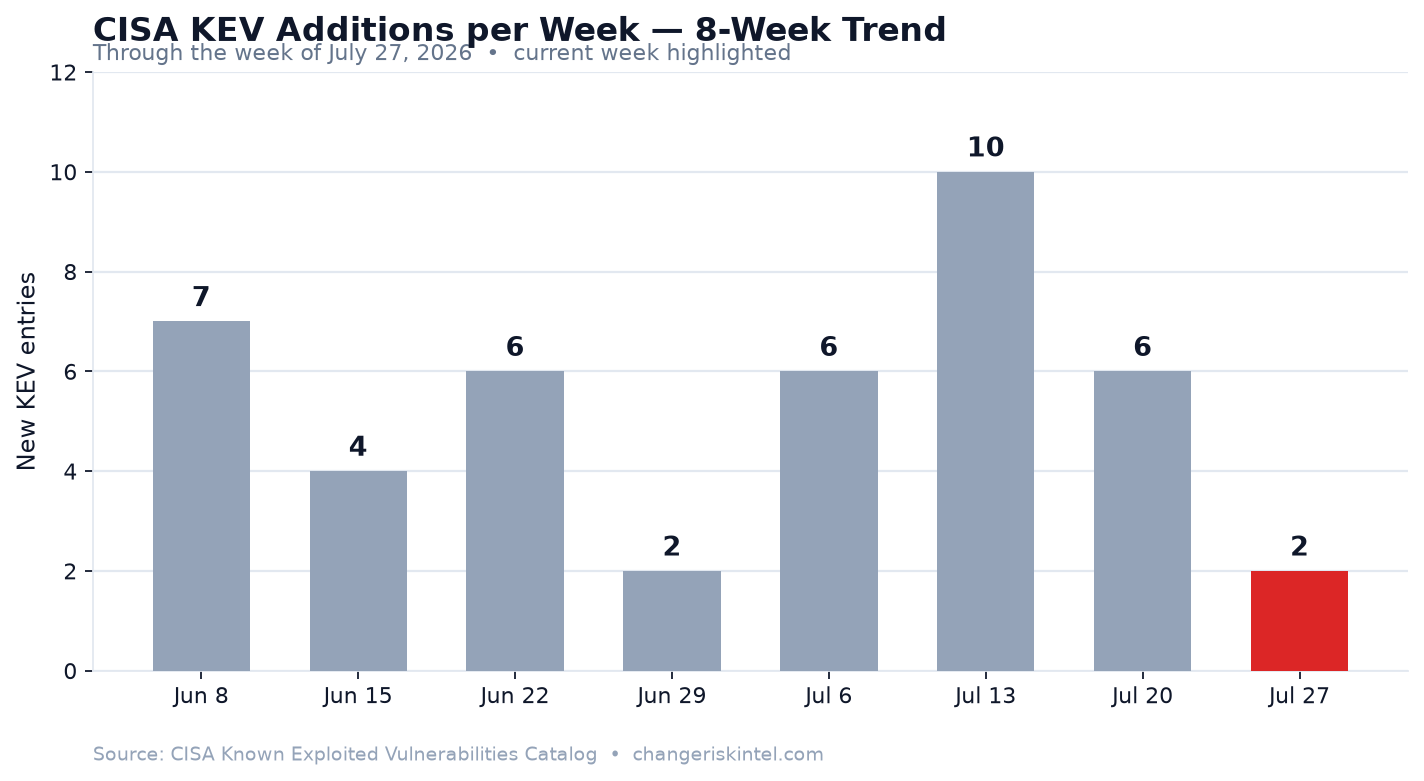
We counted CISA KEV additions per week for the last eight weeks, drawing on the catalog’s weekly releases (version 2026.07.29, 1,656 total entries). This week’s two additions sit at the low end of the range, matching the quiet week of June 29 and well below the July 13 spike of ten.
| Week of | KEV additions |
|---|---|
| Jun 8 | 7 |
| Jun 15 | 4 |
| Jun 22 | 6 |
| Jun 29 | 2 |
| Jul 6 | 6 |
| Jul 13 | 10 |
| Jul 20 | 6 |
| Jul 27 | 2 |
The signal for capacity planning is unchanged: KEV additions average roughly five to seven per week with occasional spikes, so a CAB sized to absorb about one emergency security change per weekday is right for a normal week — and this week’s low count is a chance to work down the backlog, not to stand down (CISA KEV catalog).
Get this every Friday
This recap goes out as our weekly newsletter — one email, the week’s change-risk signals, no fluff. Subscribe on the site to get it in your inbox every Friday morning.
Recommended reading:
- ServiceNow AI Change Risk Assessment: What CABs Must Verify
- CISA BOD 26-04: Risk-Based Patch Deadlines for CABs
- Status Page Aggregators Compared: StatusGator vs IsDown
Sources
- CISA — Known Exploited Vulnerabilities Catalog
- GitHub — Incident with Copilot AI Model Providers (community #203406)
- GitHub Status — Disruption with Actions hosted runners
- Datadog — DASH 2026 recap: product news and highlights
- DORA Auditor — ESRB frontier-AI cyber-risk warning and the ECB deadline
- Passwork — NIS2 compliance latest news, June–July 2026
Published July 31, 2026.