This Week in Change Risk — Week of Aug 3, 2026
Why this week mattered
Every Friday we round up the events that should land on a change advisory board’s radar: what got exploited, what broke, what vendors shipped, and what regulators did, filed under our cybersecurity beat. This week the theme was the build pipeline itself. A CVSS 9.8 flaw in a widely deployed CI server went on the federal must-patch list, GitHub Actions failed twice in forty-eight hours, and Microsoft signaled another large patch load for next Tuesday. Here is what a CAB should do with each.
1. KEV additions this week
CISA added two entries to its Known Exploited Vulnerabilities catalog this week, taking the catalog past 1,660 total (CISA KEV catalog). The one that demands emergency-change treatment is CVE-2026-63077, a CWE-502 deserialization flaw in JetBrains TeamCity On-Premises rated CVSS 9.8, which lets an unauthenticated attacker achieve remote code execution through the build-agent polling protocol; CISA added it August 5 with an August 8 federal deadline, and JetBrains fixed it in 2026.1.3 and 2025.11.7 (The Hacker News, JetBrains advisory). The weakness worth naming: a compromised build server is not a single-host problem. It can poison downstream CI/CD artifacts and harvest every credential the pipeline stores, turning one RCE into a supply-chain event. The second addition, CVE-2026-18577 in N-able N-central (CVSS 8.2, added August 3), we covered in Tuesday’s piece on its incomplete patch. For a CAB, TeamCity is the one that justifies pulling an emergency change: TeamCity Cloud is unaffected, but every on-prem version is in scope.
2. Cloud incidents worth noting
GitHub was again the week’s reliability story, and this time it repeated. On August 6, GitHub Actions ran degraded for roughly five hours from 15:22 UTC, with workflow runs failing to start or dying mid-run and the Actions REST API returning errors; the very next day, August 7, Actions Runner Controller pods sat idle while push and pull-request events went unprocessed (isinternetup incident log, WebProNews). AWS, Azure, GCP, and Cloudflare core services stayed clear. The recurring weakness: two outages in two days points to reliability strain on GitHub’s Actions control plane, and any organization whose deploy gate depends on a single CI provider inherited two unplanned change freezes this week with no SLA to fall back on — the same provider-of-provider risk pattern applied to CI. A CAB should now ask whether it can still ship an emergency security change if Actions is down, or whether the pipeline is a single point of failure sitting on top of the TeamCity flaw above.
3. Vendor moves
The vendor signal that matters most for change teams is the calendar: Microsoft’s August Patch Tuesday lands August 11, 2026, and forecasters expect another large release after July’s record 622-CVE month, driven partly by AI-assisted vulnerability discovery finding more issues faster (Help Net Security forecast, The Hacker News on July’s 622 CVEs). The weakness a CAB must plan around: a 600-plus CVE month is not one change, it is a triage exercise, and the standard patch window will not hold if a fifth of them are critical. Separately, Datadog and Snyk launched a GitHub integration that surfaces Snyk’s code-level vulnerability analysis inside Datadog for prioritization (Datadog investor release). Useful for ranking what to change first, but the weakness to name is that a prioritization score is an input to a CAB decision, not a substitute for one, and a tool that ranks by exploitability can still miss a low-CVSS flaw that chains into something worse.
4. Compliance and regulatory
NIS2 stayed the week’s live regulatory thread. Our Wednesday runbook on Article 23 incident reporting walked the 24-hour early-warning, 72-hour notification, and one-month final-report clock, and the timing is not academic: the TeamCity RCE and the GitHub Actions outages above are exactly the kind of events that, for an in-scope essential or important entity, can start that 24-hour clock the moment they are detected (ENISA NIS2 guidance). The change-management read: incident reporting is a CAB dependency, not just a security-team task, because the remediation changes you file during an incident are part of the record regulators will ask for. A financial-sector CAB should also keep DORA’s ICT-incident timelines in view, since the two regimes overlap for banks and their critical third parties. The practical step this week is to confirm that your change record and your incident-reporting workflow share a timestamp source, so the 24/72/one-month narrative reconstructs cleanly.
5. From the change-management community
The week’s most useful community thread, on r/sysadmin and Hacker News, was practitioners reacting to the GitHub Actions outages by asking a blunt question: what is our fallback when the pipeline is the incident? The consensus worth borrowing is that “our CI provider” belongs on the change register as a named external dependency, with a documented manual-deploy path for emergency security changes — because the week’s TeamCity KEV had an August 8 deadline that a CI outage could have blown straight through. Several posters noted the irony that the tool teams use to ship patches was itself the thing that stopped them shipping. Treat the CI pipeline as a change actor and a single point of failure at once: it is both how you remediate and something that can itself need remediating. That dependency mapping is the kind of thing our CAB agenda generator is built to surface before an incident, not during one.
6. Chart of the week
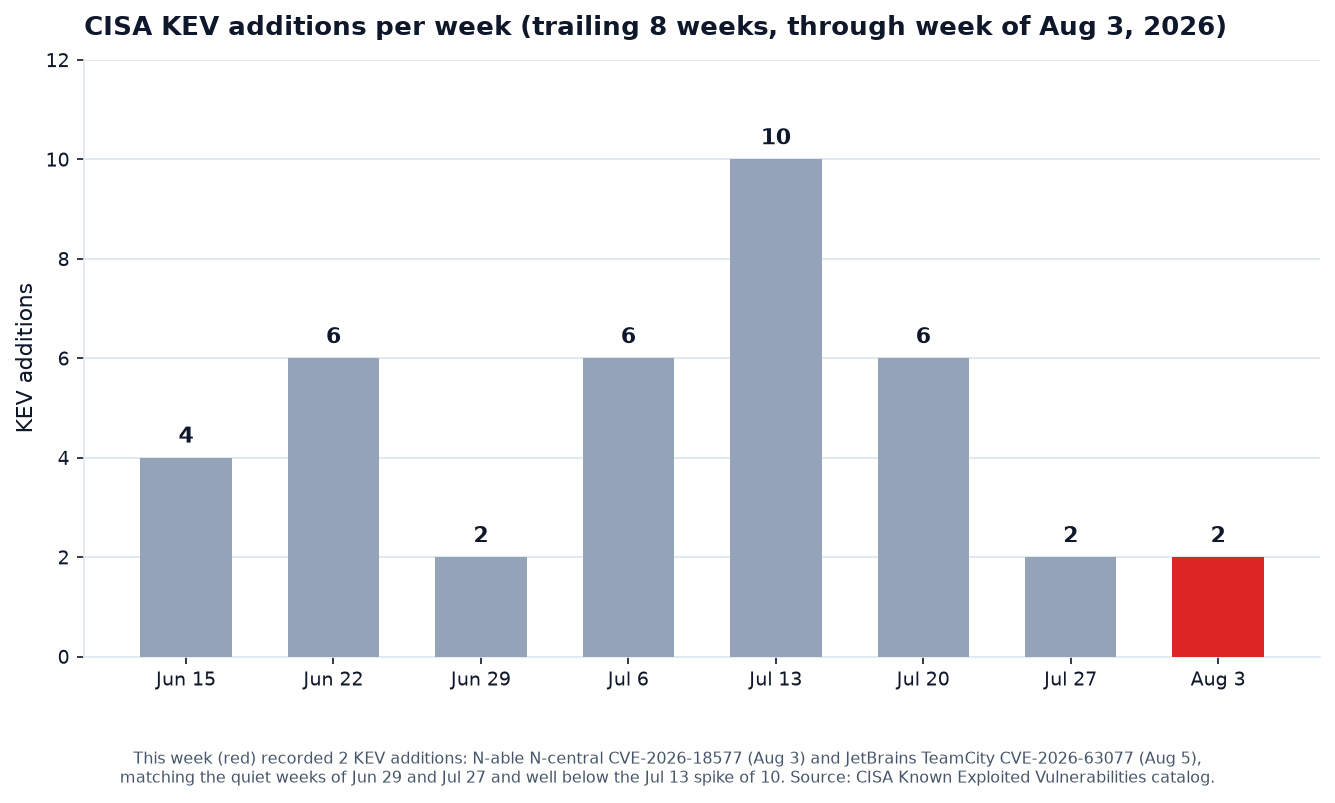
We counted CISA KEV additions per week for the last eight weeks, drawing on the catalog’s weekly releases. This week’s two additions sit at the low end of the range, matching the quiet weeks of June 29 and July 27 and well below the July 13 spike of ten.
| Week of | KEV additions |
|---|---|
| Jun 15 | 4 |
| Jun 22 | 6 |
| Jun 29 | 2 |
| Jul 6 | 6 |
| Jul 13 | 10 |
| Jul 20 | 6 |
| Jul 27 | 2 |
| Aug 3 | 2 |
The signal for capacity planning is unchanged: KEV additions average roughly five per week with occasional spikes, so a CAB sized to absorb about one emergency security change per weekday is right for a normal week. A low-count week like this one is the moment to work down the patch backlog before Tuesday’s Microsoft release lands, not to stand down (CISA KEV catalog).
Get this every Friday
This recap goes out as our weekly newsletter — one email, the week’s change-risk signals, no fluff. Subscribe on the site to get it in your inbox every Friday morning.
Recommended reading:
- N-able N-central KEV: When the Emergency Patch Is Incomplete
- NIS2 Article 23 Incident Reporting: A 24/72/1-Month CAB Runbook
- Cross-Region Failover Testing: Why Untested DR Fails
Sources
- CISA — Known Exploited Vulnerabilities Catalog
- The Hacker News — CISA flags TeamCity CVE-2026-63077 RCE
- JetBrains — TeamCity CVE-2026-63077 security advisory
- isinternetup — GitHub Actions incident log, August 7, 2026
- WebProNews — GitHub Actions outage and reliability strain
- Help Net Security — August 2026 Patch Tuesday forecast
- Datadog — Datadog and Snyk launch GitHub integration
Published August 7, 2026.