This Week in Change Risk — Week of Nov 16, 2026
This weekly digest is operational intelligence for change and risk owners. No affiliate links appear in this post.
Welcome to This Week in Change Risk for the week of November 16, 2026. The KEV list was shorter than last week, but it hit closer to the change process itself: one entry sits in configuration management, another in an AI gateway’s guardrail tooling. With US Thanksgiving next Thursday, the useful question for most CABs is which of these must clear before a freeze starts.
Two posts went up this week. Monday’s retry storms CAB check reads GitHub’s root cause analysis next to AWS’s new SDK retry defaults, and Wednesday’s feature flag platforms comparison looks at LaunchDarkly, Unleash and Flagsmith as change control.
KEV additions this week
CISA’s KEV catalog added seven entries from November 13 to 18. Five carry a three-day deadline under BOD 26-04, all five with the forensic triage flag. The two 14-day entries carry no flag, the same split we charted last week. The catalog had no further additions through November 19.
The two entries CISA added on November 13 were due November 16, so the clock ran over a weekend:
- Check Point, CVE-2026-123039: a local privilege escalation in the Gaia OS DynamicCLI daemon, which runs as root on a world-writable socket (sk1000362). On its own it needs local access. Check Point’s security advisory says attackers chained it with PHP2Shell in the Mobile Access Portal from October 30 to November 4, and that fixes “were available one week before the attack, on October 23rd.” It counts “a couple of dozen unpatched systems, in a single region” as compromised. We covered the PHP2Shell side in our php2shell emergency change post.
- UnrealIRCd, CVE-2026-114713: on any network with two or more linked servers, a normal user can inject server-to-server commands. UnrealIRCd 6.2.7.1 shipped November 7, and the project says that on “almost all UnrealIRCd 6 networks” the fixes can be hot-patched without a restart.
Check Point’s weakness is in the version list. The SK names six affected versions, including R81.10 and R81, but lists Jumbo Hotfix takes only for R82.20, R82.10, R82 and R81.20, and the advisory lists only those four. If you run R81.10 or R81, get a written answer from Check Point before you close the change.
The one entry added on November 17 has a 14-day deadline and no triage flag, but it deserves the most CAB attention:
- Perforce Puppet Enterprise, CVE-2026-115731: a deserialization flaw in report processing. Per the Perforce advisory, any client with a CA-signed agent certificate can run code on Puppet Server, and “where the certificate authority autosigns requests without strong verification, an unauthenticated network attacker can obtain such a certificate.” Fixed releases are Puppet Enterprise 2026.0.1, 2025.12.1 and 2023.8.13. It is due December 1.
Puppet Server is the system that pushes configuration to every managed node, so control of it is control of your change delivery. Puppet’s release page says the same update fixes a second bug, CVE-2026-115732, which let one managed machine pose as another, and removes the compromised eMudhra intermediates from bundled trust stores (our eMudhra trust store runbook covers that side). It is not on the KEV list. Two weaknesses to note: Perforce’s advisory gives the fixed open-source build as Puppet Core 8.22.2, while the release page says 8.22.1, so check the build you actually install. And the upgrade is itself a change to the tool that makes changes, so stage it like one and review whether your CA autosigns.
The four entries CISA added on November 18 split into two tracks:
- Synology DSM, CVE-2024-10441: due tomorrow, November 21, triage flagged. The fixed releases are in Synology’s SA_24_20, first published in November 2024, for example DSM 7.2.2-72806-1. This is a two-year-old fix, so the real question is which NAS units never took it. Check the running build on each device.
- REDCap, CVE-2026-90817: due November 21, triage flagged. An unauthenticated attacker who knows a valid public survey hash can run code on the server. NVD lists fixed versions 16.0.49, 17.3.10 and 17.4.4. The vendor link in CISA’s entry goes to the REDCap community page, which shows no public bulletin, so institutions without consortium access will have to work from NVD.
- Apache Axis, CVE-2026-90436: due November 21, triage flagged. The Apache Axis notice marks Axis 1.x “UNSUPPORTED WHEN ASSIGNED” and says the project “does not expect to create an Axis 1.x release fixing this problem.” The options are to migrate to another SOAP engine or build Axis with the published patch. Axis 1.x usually sits inside other products, so the change record is a dependency search first. If it turns up in a vendor product, the fix depends on that vendor.
- BerriAI LiteLLM, CVE-2026-40217: due December 2, no triage flag. The LiteLLM advisory says the guardrail test endpoint ran user code in a sandbox that could be escaped, and that reaching it “requires a proxy-admin credential in default configurations.” Its interim workaround is to block
POST /guardrails/test_custom_codeat the reverse proxy. The weakness is the version guidance: the advisory header lists 1.83.10 as patched, while the text says “Fixed in 1.83.11.” Target 1.83.11 or later.
The change-window implication is the holiday. US Thanksgiving is November 26. Last week’s four 14-day entries (Outlook, Chromium, Cisco BroadWorks and Openwave) are due November 24, and Puppet and LiteLLM fall due December 1 and 2, right after the long weekend. If your freeze starts November 25, both need to clear CAB next week or get an explicit freeze exception with a named owner. Our Q4 change freeze plan sets out an exception path for exploited bugs during a freeze.
One major item was not a KEV entry. On November 17, CISA urged organizations to patch Java4Shell, CVE-2026-114938, a memory-corruption bug in the HotSpot JVM’s Base64 decoder. Oracle’s November advisory scores it CVSS 8.1, with high attack complexity and no authentication needed, and lists affected Java SE 8, 17, 21, 25 and 27 builds. The Canadian Centre for Cyber Security says exploitation needs x86-64 processors with AVX-512 VBMI, and that it is “not aware of active exploitation at this time.” CISA’s most useful line is about inventory: “JDKs and Java runtimes may not appear as separate entries in software inventories.” Expect the work to go into finding bundled runtimes in appliances and container images before any patching starts. Oracle’s advisory also says “security patches are released on the third Tuesday of each month,” alongside its quarterly Critical Patch Updates, so Java needs a monthly slot on the change calendar next to the Patch Tuesday calendar, not only a quarterly one.
The live KEV tracker has every entry.
Cloud incidents worth noting
Cloudflare shipped a breaking change and rolled it back. From 06:48 to 08:56 UTC on November 19, its Access status entry said: “A recent Cloudflare Access release removed the sub claim from service token JWTs, which can cause authentication failures for applications that strictly validate token claims. The change has been reverted.” Applications that checked their tokens strictly were the ones that broke. For a CAB, that means a provider release can change a token contract your service depends on, and your own change log will show nothing. A synthetic login with a real service token, running all the time, catches this faster than a user ticket. The weakness is the record: the entry gives no detail beyond that update, and the day before, a separate Access incident delayed configuration changes for about 90 minutes. The Workers Event Subscriptions issue from last week was still marked “identified” when we checked, with no update since November 11.
GitHub has now posted the root cause for the November 10 Git Operations and Pull Requests incident we flagged last week. It says “recent changes increased background processing and the work required to compute pull request merges,” which put pressure on the same systems that serve customer requests. GitHub mitigated it by disabling “a recent merge-processing optimization,” pausing background analysis and limiting lower-priority traffic.
Pull request merges then timed out again twice. On November 13, up to 3% of merge requests timed out. On November 16, merge timeouts ran at 2 to 4.75% against a baseline near 0.2% from 11:59 to 16:26 UTC, and partway through GitHub said its mitigations “so far have not materially improved performance.” Neither has a root cause yet. If your release pipeline merges through the API, treat a merge timeout as a reason to pause the pipeline, not retry in a loop. Monday’s retry storms post explains why.
A smaller GitHub item makes a point about how long a regression can hide. Its November 19 update says that from November 5, web sessions “stopped being renewed based on recent activity” because of a bug in session renewal, “not due to a security incident,” and that the fix landed at 05:23 UTC on November 19. That is two weeks between the start and the fix. A post-change check that only looks for errors in the first hour would not have caught it.
Vendor moves
Atlassian has set a December 15 deadline for Jira Service Management portal forms. Per the JSM Cloud changelog, from that date, Forge apps using UI Modifications on portal request-create forms must declare JSM-specific scopes, or the modifications “will not execute.” If your change or access-request portal relies on such an app to show, hide or require fields, check with the app vendor now. The weakness is the timing. Atlassian also says “declaring only the previously accepted Jira scopes will no longer be sufficient,” and an app that doesn’t update in time stops quietly in mid-December, often inside a freeze.
GitHub made two moves that matter for change evidence. Enterprises on GitHub Enterprise Cloud with data residency (GHE.com) can now stream audit logs to Amazon S3 using OpenID Connect, without storing long-lived AWS keys on GitHub. That removes one secret from the evidence pipeline auditors already ask about. GitHub also made Enterprise Live Migrations from Azure DevOps generally available. Repositories sync continuously and teams cut over when ready, so the cutover is the change to schedule. The weakness is coverage. The migration announcement covers GitHub Enterprise Cloud with data residency, and the OIDC streaming option reached GHE.com only after github.com, so check which platform a changelog entry applies to before you plan around it.
Chart of the week
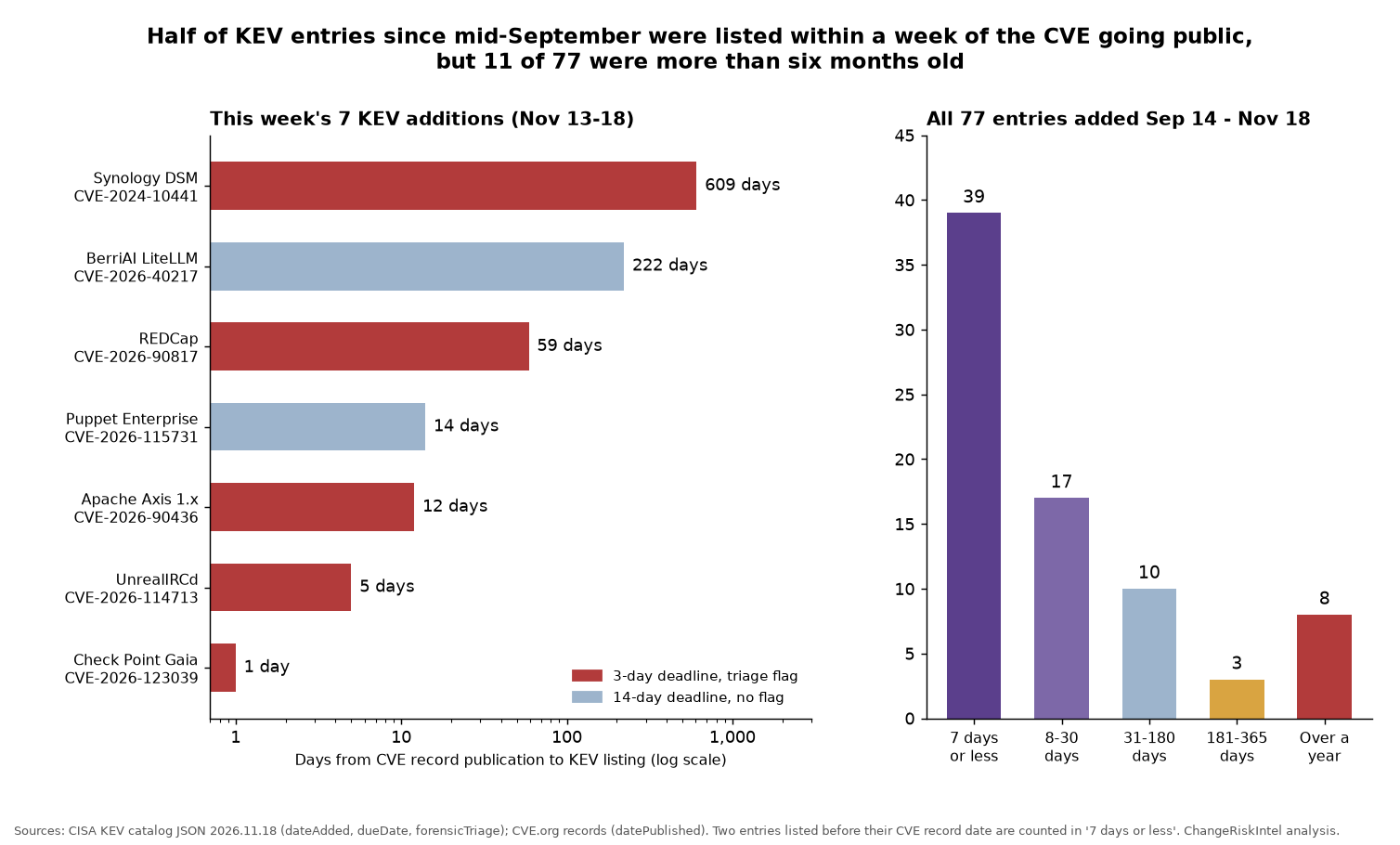
This week’s list ranged from a Check Point bug listed the day after its CVE record went public to a Synology bug listed 609 days after. So we measured the gap for every entry since mid-September, matching each KEV catalog date to the publication date on its CVE.org record.
Of 77 entries added from September 14 to November 18, 39 were listed within a week of the CVE going public, and the median gap was six days. But 11 entries were more than six months old when CISA listed them, and eight were more than a year old. Two entries were listed before their CVE record’s publication date. We counted those in the first bucket.
For a CAB, the short gaps mean emergency changes, which the three-day deadline already forces. The long gaps are a different problem. When a fix has existed for a year or more, the change is usually not a new patch. It is proof that the old patch actually reached every device. For entries like Synology this week, close the record on the running version of each asset, not on the date the vendor fix shipped.
The newsletter
If you want this digest in your inbox every Friday, subscribe to the changeriskintel newsletter and get the week’s KEV additions, cloud incidents and change-management lessons without the noise.
Recommended reading
- Retry Storms as a CAB Check: GitHub’s RCA and AWS’s New Defaults
- Feature Flags as Change Control: LaunchDarkly, Unleash, Flagsmith
- php2shell KEV Deadline: Evidence First, Then the Emergency Patch
- eMudhra Certificate Compromise: A Trust Store Change Runbook
- October 2026 Patch Tuesday: A CAB Plan Through Year-End
More weekly analysis lives on our cybersecurity pillar.
Sources
- CISA Known Exploited Vulnerabilities Catalog
- CISA KEV catalog JSON feed
- CISA: CISA Adds Two Known Exploited Vulnerabilities to Catalog (November 13)
- CISA: CISA Adds One Known Exploited Vulnerability to Catalog (November 17)
- CISA: CISA Adds Four Known Exploited Vulnerabilities to Catalog (November 18)
- CISA: BOD 26-04 Prioritizing Security Updates Based on Risk
- CISA: Critical Java Vulnerability Requires Immediate Patching (November 17)
- Check Point sk1000362: CVE-2026-123039
- Check Point: Active exploitation of PHP2Shell and local privilege escalation
- UnrealIRCd: 6.2.7.1 release and hot-patch
- Perforce: Report deserialization code execution (CVE-2026-115731)
- Puppet Enterprise: Updates and releases
- Synology Security Advisory Synology_SA_24_20
- NVD: CVE-2026-90817 (REDCap)
- REDCap community resources
- Apache Axis: CVE-2026-90436 notice
- LiteLLM security advisory GHSA-wxxx-gvqv-xp7p
- Oracle Critical Security Patch Update Advisory, November 2026
- Canadian Centre for Cyber Security: AL26-029 Oracle Java CVE-2026-114938
- Cloudflare Status: Cloudflare Access Issue (November 19)
- Cloudflare Status: Cloudflare Access Issue (November 18)
- Cloudflare Status: Changes to Workers are not producing Event Subscription events
- GitHub Status: Incident with Git Operations and Pull Requests (November 10)
- GitHub Status: Incident with Pull Requests (November 13)
- GitHub Status: Incident with Pull Requests (November 16)
- GitHub Status: Disruption with some GitHub services (November 19)
- Atlassian: Jira Service Management Cloud changelog
- GitHub Changelog: S3 audit log streaming with OpenID Connect expands to GHE.com
- GitHub Changelog: Enterprise Live Migrations from Azure DevOps generally available
- CVE.org CVE records API
Published November 20, 2026.